
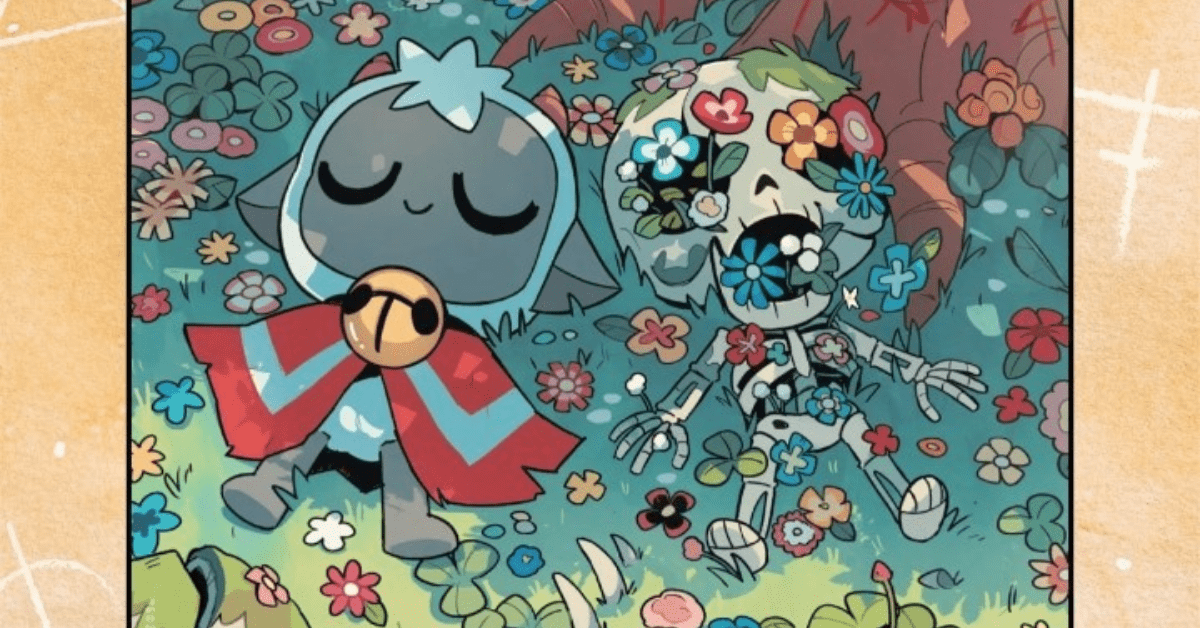
Written by Alex Paknadel and illustrated by Troy Little, Cult of the Lamb Vol. 1: The First Verse is a calculated continuation of the young Lamb’s story after his slaughter in the video game.
A Calculated Continuation of the Cult of the Lamb Video Game
I remember when the Cult of the Lamb video game came out. I watched a playthrough from start to finish, intrigued by the storyline. So, imagine my surprise at finding a webcomic on Niuhi surrounding this series that dives deeper into the established lore.
While I do know the ending for that tale, I have to wonder if the narrative will be retold to end differently. After all, we learn that the Lamb – the last of his kind – is deemed an “endling”, a heretic to the chief Four Old Gods. Judging by Lamb’s conversation with The One Who Waits, the Eldritch god who wanted to use him as a vessel, the Lamb was this god’s last prophesied hero.


Analyzing the Demonology and Eldritch Gods in The First Verse
Living in hiding (and with yet unshared knowledge of his mother’s backstory), the Lamb congregated with solitude, save a symbolic exchange of food and books for a shearing of his fleece by a farmer. As we learn from some of the Four Eldritch Bishops of the Old Faith’s acolytes, their lands are cursed with ruin and pestilence. And judging by The One Who Waits’ words and Lamb’s inherited lands, it may be the result of the latter god’s curse set upon them and their tide.
Like any good story of occult nature, Lamb made a pact with the “demon” betwixt the crossroads of life and death, trading his soul’s rebirth in exchange for revenge on the monsters who sold him out and stole away his (relatively peaceful) life.
The Significance of Real-World Sigils and Symbols
I find it interesting that the fight between the Old Gods is apparent in every piece of nature in both the Darkwood of the Old Gods and The One Who Waits ruined chapel built on consecrated ground.
(The Clear web would have you believe the Leviathan Cross is exclusively “satanic” despite its origin as an alchemical symbol, and the Lorraine Cross is associated with Joan of Arc despite its creation long before her time.)


You can see each sigil that lines up with each power, principality, and god on each tree, stone, and vessel they have marked under their authoritative dominion.
Even the sacrifice circles bear the marks of those entities who work in tandem toward a common, unknown goal.
I say unknown because I feel like it has to be something more than the basic, at face value, “this older god cursed our lands, so we kill and destroy all of their chosen, marked vessels because we want complete dominance over all of the lands”.
In reality, it’s never that simple.
If The One Who Waits wanted something more, why use the Young Lamb – a race docile in nature who, as the story dictates – is at war with itself in addition to the enemies of his people?


I guess The One Who Waits thinks it would be easiest to strip power from the Lamb (as opposed to somebody from Ratau’s jealous race) but if the Lamb doesn’t actually allow himself to be corrupted by the divine power and fights his nature to restore peace to the Darkwood and all lands, wouldn’t The One Who Waits still be the other Old Gods “reckoning”? And the Lamb, last of their kind, would still be an “endling” because he ended all of their dominion and brought divine power to themselves?
I don’t know, I could be totally off in my interpretation but what are your thoughts? Have you played the Cult of the Lamb video game before?
You can read Cult of the Lamb on the Niuhi App, and purchase the video game via their website.
Leave your thoughts in the comment section below, we’d love to hear from you! Also be sure to follow us for more Comics & Graphic Novel Reviews!
☆ In Asian Spaces ☆ Ephesians 6:12 ☆



Leave a Reply