
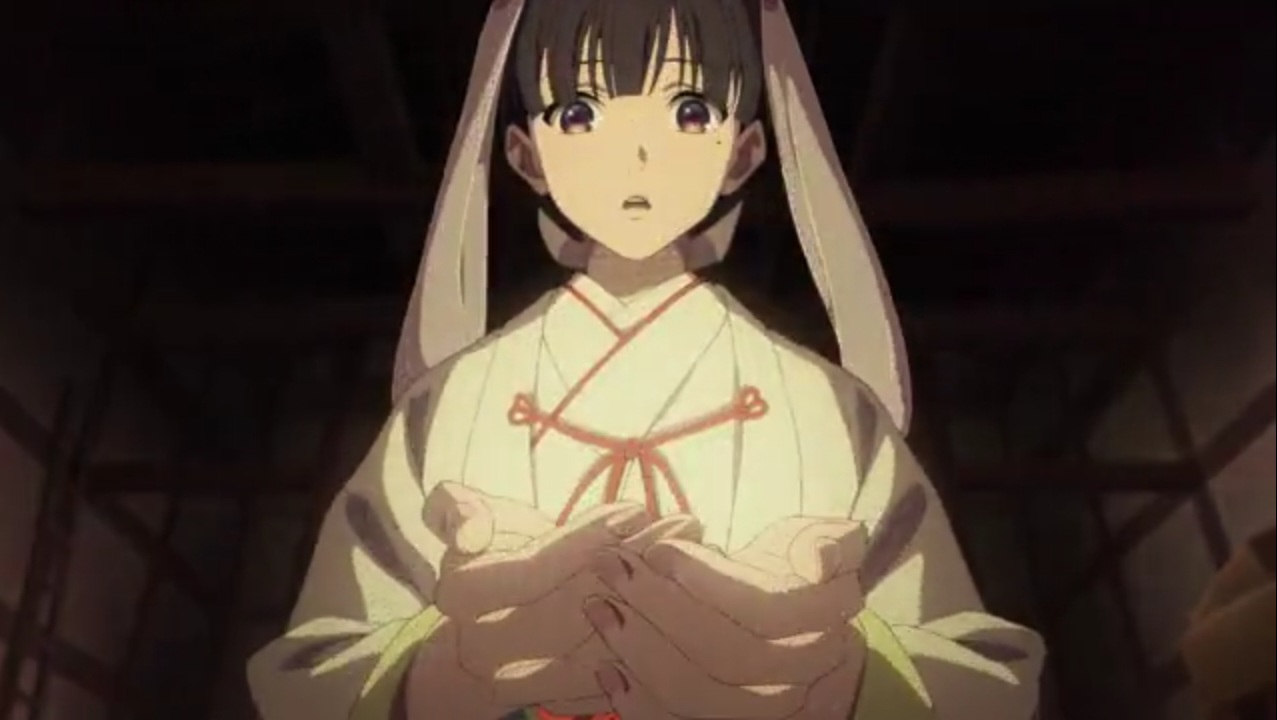
My Happy Marriage is an anime that defied my expectations. I went in knowing the premise was related to an arranged marriage with supernatural abilities factored in somewhere along the way; but I left emotionally touched by a deep story filled with love, understanding, and a gentle light shown on Japan’s (lost) respect for Shintoism and those with supernatural abilities.
My Happy Marriage Season 1 Review
At first, My Happy Marriage starts off like any typical Cinderella story – which I didn’t mind, as I’ve always enjoyed that genre of brutal fairytale that ultimately has karma – maybe even divine intervention, possibly destroy Cinderella’s enemies in the end. This allows Cinderella to leave and live a new life with her prince, happily ever after all of the pain and suffering she endured for years’ time.
Saimori Miyo’s life is no different. After the death of her mother, she is essentially thrown away by her father in favor of his new wife and their daughter together, Kaya.

There is even a scene in that anime where Miyo is going about her daily life of chores and suffering, and she sits on the floor amongst the bustle and clatter of servants while wiping her face and gets her cheek smeared with soot.
In the original Cinderella, Cinderella got her name from often sitting by the fire to read books. Hence – Cinder or fire, and Ella or girl.

There is also a moment in the original Cinderella movies where her mother’s garments and personal belongings are sold, stolen, or simply destroyed – in this case being Miyo’s mother’s wooden cherry blossom comb. It was destroyed right in front of her by her stepmother for the crime of “disobedience”.
Along with Cinderella being locked in a storage room or attic, Miyo is routinely locked in a storage shed. And of course, like the original tale Miyo’s only confidant and protector is a servant named Hana. Hana is taken away from Miyo and fired for attempting to protect the (then) child from a life of hardship, cruelty, and abuse by her father, his mistress, and their daughter.
Oddly enough, the Cinderella parallels end there, and a new story is born out of this timeless trope.
A Society of Peace and Understanding in Japan
I don’t think I mentioned it yet, but My Happy Marriage is a historical drama. I love period dramas in general, so this was right up my alley. I’m not sure exactly when it takes place, but the anime seems to be set in the early 1900s after the port of entry was opened for trade by Commadore Perry – I wouldn’t gauge any further and assume the setting was past the 1920s.

Western clothing and etiquette are mixed with traditional Japanese dress and manner of speech. Western sweets are newly being imported, and Western cars are being driven by the elite over the carriages of the masses. Department stores are opening up on main street in town each day, and My Happy Marriage seemed to perfectly capture that transitory period of women still being held to a certain societal standard, but at the same time being given the freedom to express their opinion and choose their own fate.
That may sound strange to some who have watched the anime, but let me explain: we can take Kudo’s sister Hazuki as a prime example.
Kudo Hazuki’s Unsuccessful Marriage

Born into the illustrious Kudo clan, Hazuki always expected to be essentially auctioned off in a political marriage for her family. She did her duty, but regretted not knowing or being skilled enough in homemaking to make the marriage work in the eyes of her new in-laws. Hazuki and her kind husband spoke, and came to a mutual agreement that eventually led to divorce.
Hazuki regrets not trying harder to save the marriage, and judging her interactions with her brother Kiyoka, her family does not hate her or view the broken marriage as a “failure” or “stain” on their legacy. Especially since as far as we know, Hazuki was not able to produce an heir from the union – something I will touch upon a little bit later on.
Tatsuishi Kouji’s Unhappy Engagement
On the flip side, we have Tatsuishi Kouji, the second-born male of the Tatsuishi clan who is acting as the assumed heir due to his older brother Kazushi’s flaky nature.
Kouji desires to be with Miyo, a woman he is implied to have known since childhood.

Kouji wants to save Miyo from the abuse she suffers each day in the Saimori home, and Miyo seemed to view their interactions as a peaceful respite from her harsh daily live. The head of the Tatsuishi clan, Kouji’s father seemed to have other plans – instead wanting Miyo for his eldest son based on her Usuba bloodline from her mother; Instead forcing Kouji to marry Miyo’s obnoxious little sister, Kaya.
Both Kouji and Kaya keep up the farce and pretend they are happy in public, while in private they have passive-aggressive sessions of bickering.

When Kouji finds out that his father knew of Miyo’s abuse but ignored it, he blew up and was quickly subdued by his father in a supernatural ability battle. Wanting to save Miyo who had been kidnapped at his father’s behest, Kouji teams up with Kudo to get her back – in the process realizing his own weakness and acknowledging Kudo’s strength and more importantly, Miyo’s happiness with Kudo.

In a final conversation, Kouji essentially wants to know if Miyo is happy, and she shares that she is. Kouji brings up the time he was about to formally confess his feelings to Miyo, and Miyo quickly (but politely) declares that she does not recall the interaction. The silent implication being that both of them remember this occurrence, but Miyo has moved on, and Kouji respects this boundary.
Kouji does not become jealous or irrational; he accepts that Miyo is happy (which is what he desired) and even decides to journey to the capital to hone his skills to be worthy enough to protect those he cares for. He even tries to reconcile with Kaya, who in typical Cinderella fashion, is now being sent to work as a servant in a harsh household after losing it all in a fire of her own making.

Because Kaya is childish and hurt, she rejects Kouji’s proposal to continue their marriage agreement – despite the engagement most likely being broken when Kudo forced their father to step down as head of the Tatsuishi clan in favor of his older brother, Kazushi.
Usuba Sumi’s Dismal Marriage
And now, as the final subversion of the Cinderella tale, we have Usuba Sumi’s marriage into the Saimori family.

Usuba Sumi (going by the clan alias of “Tsuruki”) decided to marry Shinichi in an arranged marriage of her own volition, in order to save the family company, Tsuruki Trading, from going out of business due to extreme debt.
Sumi’s father and head of the Usuba clan, Yoshirou, had refused the marriage offer many times over before Sumi accepted it behind his back. We learn from Miyo’s cousin (and proposed husband by their grandfather due to Usuba traditions) Arata that the Usuba family only intermarries, and does not have close friendships nor romantic relationships with outsiders.
As this revelation comes towards the end of season one, and given the Usuba’s (basically ninjutsu) psychic powers being specifically for subjugation of the of other supernatural ability users should they fall out of line as dictated by “Mikado” the emperor, the big fuss about Shinchi essentially throwing his firstborn away due to her (perceived) lack of supernatural ability from a union with a secretive but powerful clan that never marries out is understandable.
Sumi was ill, and her body was frail.

Despite this, after Miyo was born, Sumi discovered Miyo’s psychic abilities as an infant, and later used the last of her life force to seal Miyo’s magical abilities using a sakura tree that was planted for her wedding. Sumi passes soon afterward, and we see that the seal held up until Miyo was 19, as she did not pass the test for spirit sight and was discarded by her father at the age of 3.

Given the context, we can piece together that Shinichi never even attempted to love Sumi, as while Sumi was sealing Miyo’s powers, she gave Miyo the memories of overhearing the Saimori clan planning to get her pregnant again due to Miyo’s lack of spiritual abilities, despite Sumi’s already frail condition.
Adding in Kudo’s research, we now know that Shinichi’s current wife was his mistress, and that is why she hated Miyo and raised her daughter Kaya to believe that she was superior to Miyo in every way – despite Miyo inherently being superior due to being the firstborn and, of course, the Usuba clan’s psychic and genetic bloodline.

Shinichi views Miyo as useless because the dowry for her mother was basically Tsuruki Trading’s debt, and Miyo being conceived with what he believed to be no power, was a waste of money and a stain on the Saimori legacy to essentially lose out on a union with the elusive Usuba clan.
What’s funny is that Kudo is told by Miyo’s grandfather that he wasn’t sure Miyo had developed any psychic abilities, and that is why she was left at the Saimori home despite their knowledge of the ongoing abuse. While in private (and with Arata), the grandfather admits Sumi sealed her daughter’s powers, and that he regretted losing contact with his daughter after the marriage into the Saimori clan.
I find this ironic, because had the grandfather actually taken Miyo in, she would most likely have accepted Arata as her husband and protector, but due to the nature of Sumi’s seal (awakening the power when it was needed) Miyo’s powers would most likely have remained sealed.
(As they were necessary to break the curse put on Kudo by the grotesqueries.)

Arata seemed to express that same sort of emptiness and purposelessness in life that Miyo had been feeling up until she met Kudo, and began living with him. But because of love, Miyo was able to overcome those feelings of isolation and loneliness due to the abuse and neglect she suffered at the Saimori home.
My Happy Marriage’s overall story could have developed into many different branches after employing the Cinderella trope in its narrative. I’m glad that it eventually worked its way out of it, and evolved into something uniquely its own.
But, what do you think?

Do you think My Happy Marriage managed to subvert the Cinderella trope successfully, or do you think they could have done more to distance themselves from it?
Leave your thoughts in the comment section below, we’d love to hear from you! Also be sure to follow us for more Anime Series Reviews!
☆ In Asian Spaces ☆ Ephesians 6:12 ☆




Leave a Reply