
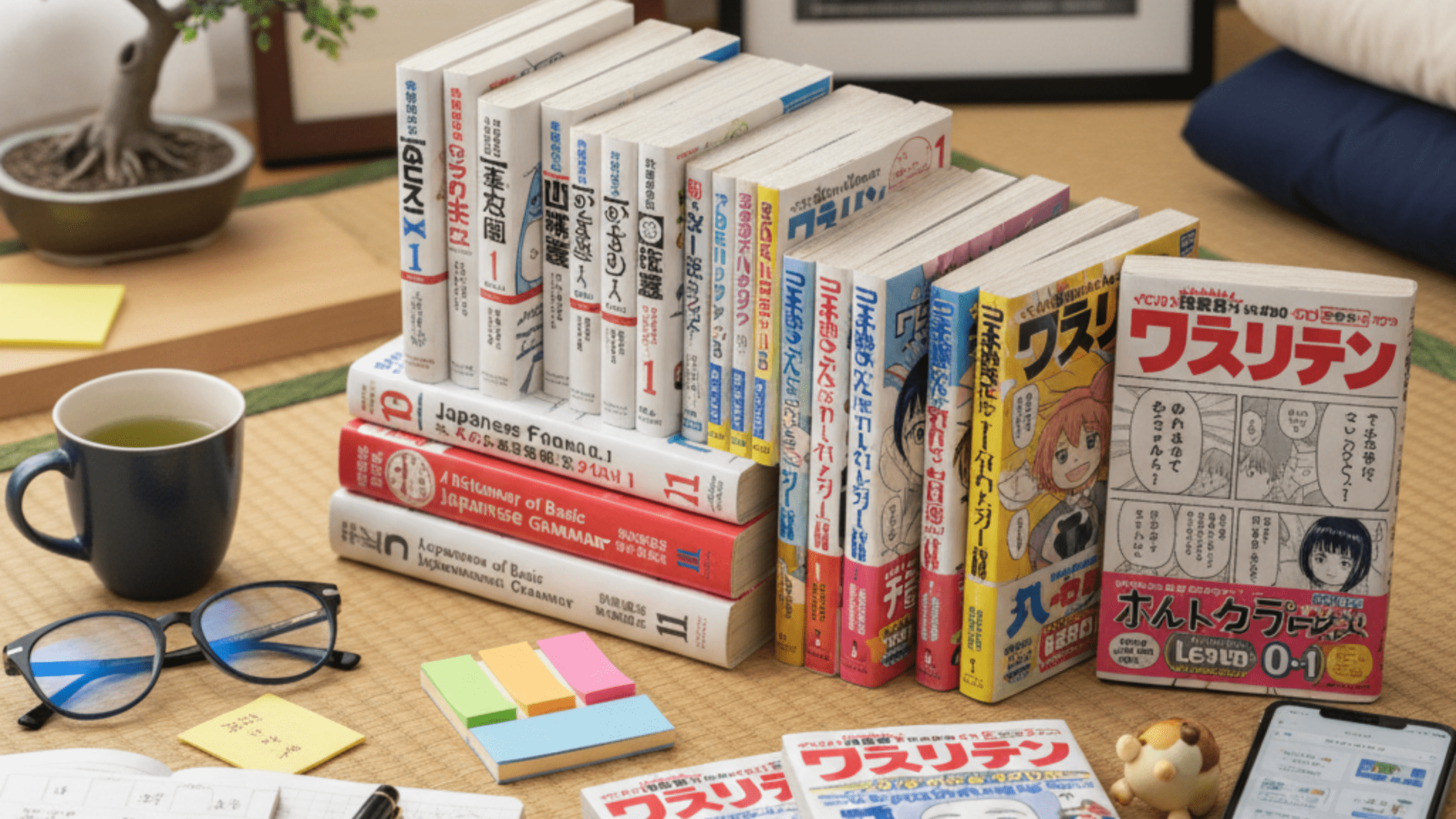
This Manga Starter Pack is designed for the high-intent learner who wants to bridge the gap between ‘textbook Japanese’ and the way people actually speak. A gift guide for self-studiers and course-takers ready to “read the room”, or [ 空気を読む] in Japanese.
While formal courses teach you the “polite speech” foundations [です and ます forms], manga is the wild west setting where you observe colloquialisms, sentence-ending particles, and gendered speech in context. While reading about how Japanese people naturally communicate with another and when using manga as a study resource, the key is using visual context to decipher natural dialogue while cross-referencing vocab and grammar books to check your accuracy.
Slice of Life Manga Great for Self Study
While textbooks give you the rules, manga shows you how native speakers actually use them in daily life. From the simplified dialogue of slice-of-life stories to the helpful visual context of four-panel comics, reading native content is a powerful supplement to any Japanese language study routine.
This Manga Starter Pack features 10 beginner-friendly titles that will help you transition from classroom Japanese to the vibrant, informal language found on the streets of Tokyo.
Yotsuba&! (よつばと!)
This is one of the “universal beginner manga”. Because the protagonist is a child, she speaks simply and makes mistakes that other characters correct—essentially teaching you alongside her. Yotsuba&! is great for learning how adults simplify their speech for children, and vice versa.


Study Tip: Pick one page of Yotsuba&! and look up every single word. Write down the grammar points you don’t recognize to circle back to for future study.
Chi’s Sweet Home (チーズスイートホーム)
Chi’s Sweet Home follows a cat as the main character, and relies heavily on short sentences and visual storytelling. It’s perfect for someone only a few months into self-study. This manga title is helpful for self-study because it focuses on cute animal speech, and basic household commands like “Don’t do that!” or “Eat up!”.


Shirokuma Café (しろくまカフェ)
My personal favorite on the list and one I’ve used in my own Japanese self-study, Shirokuma Café is a story comprised of animals and humans working alongside one another at a café in Canada, and focuses a lot on Shirokuma (Polar Bear) and his various skits that use Japanese puns, onomatopoeia, and wordplay.


Again, the main characters are animals, so you have a chance to learn both animal names and hear casual speech amongst friends of differing ages and social rank. The café food orders also bridge the gap between discerning formal ordering etiquette from casual banter.
High School & Daily Life Manga Titles
If you are taking a formal course, these will supplement your “school” vocabulary with the slang and spoken shortcuts used by real students.
Ruri Dragon (ルリドラゴン)
A highly recommended internet favorite that features very modern, realistic Japanese used by teens today. Colloquial wise, it is a perfect illustration of how real high schoolers drop particles [like omitting を or が] while still being grammatically clear. (Think about how friends casually speak in anime like A Sign of Affection or even Tokyo Revengers).


Flying Witch (ふらいんぐうぃっち)
Set in rural Aomori, it introduces soft colloquialisms and gentle sentence endings without the aggressive slang found in action or shonen series. There is a focus on relaxation and slow-paced dialogue.


Karakai Jouzu no Takagi-san (からかい上手の高木さん)
The Teasing Master Takagi-san manga has repetitive scenarios and uses similar grammar structures repeatedly, reinforcing language learning and naturally embodying the strategy of the Spaced Repetition System.


References to Power Up Your Japanese Language Proficiency
To get the most out of these manga, readers need a buffer zone that provides clarity for the slang that Genki doesn’t cover.
Japanese the Manga Way by Wayne Lammers
I own this book, I love this book, and it was originally what inspired my first post I made regarding “learning Japanese through manga” that I linked to in the Shirokuma Café section.

This isn’t a manga, but rather a ‘textbook’ that uses real manga panels to explain and more easily understand (seemingly) complex grammar discussed in other formal textbooks.
It explains things like contractions (like how ~shite iru becomes ~shiteru) and sentence particles (ze, wa, zo, na) that are key to mastering natural and organic Japanese speech that doesn’t make you sound like an edgy shonen manga character, or be perceived as a toddler who can’t even manage to form a sentence, much less manage a “Nihongo jouzu” from a native speaker.
Where to Find these Manga
For physical Japanese editions, Kinokuniya is the best option for in-person browsing in major US cities or online. CDJapan or Amazon Japan would be best for international shipping of the latest tankobon volumes.
For used physical Japanese editions of manga, places like Book-Off or Mandarake would be excellent for finding bargains on older titles like Doraemon or Yotsuba&!, and for good deals on acquiring full sets of older series.
For digital editions of Japanese manga, BookWalker is a popular platform and the industry leader for digital manga with various “free first volume” promotions to look out for and take advantage of, while ComicWalker and Pixiv Comic are fantastic for legally reading free chapters of newer titles like the aforementioned Ruri Dragon.
Stepping away from the textbook and into the world of Anime & Manga is one of the most exhilarating milestones for any language learner. These ten manga titles offer more than just entertainment – they serve as a bridge to the colloquial expressions and cultural nuances that formal courses often miss, or completely glaze over.
Don’t be afraid to struggle with a few kanji or look up a slang term – every page you turn is a victory on your journey of Japanese language study. Grab a volume of Chi’s Sweet Home or Shirokuma Cafe, find a comfortable spot, and have fun as you start experiencing the Japanese language exactly as it was meant to be enjoyed!
Do you have a favorite manga series you use to study Japanese, or any other language?
Leave your thoughts in the comment section below, we’d love to hear from you! Also be sure to follow us for more Japanese Language Study!
☆ In Asian Spaces ☆ Ephesians 6:12 ☆



Leave a Reply