
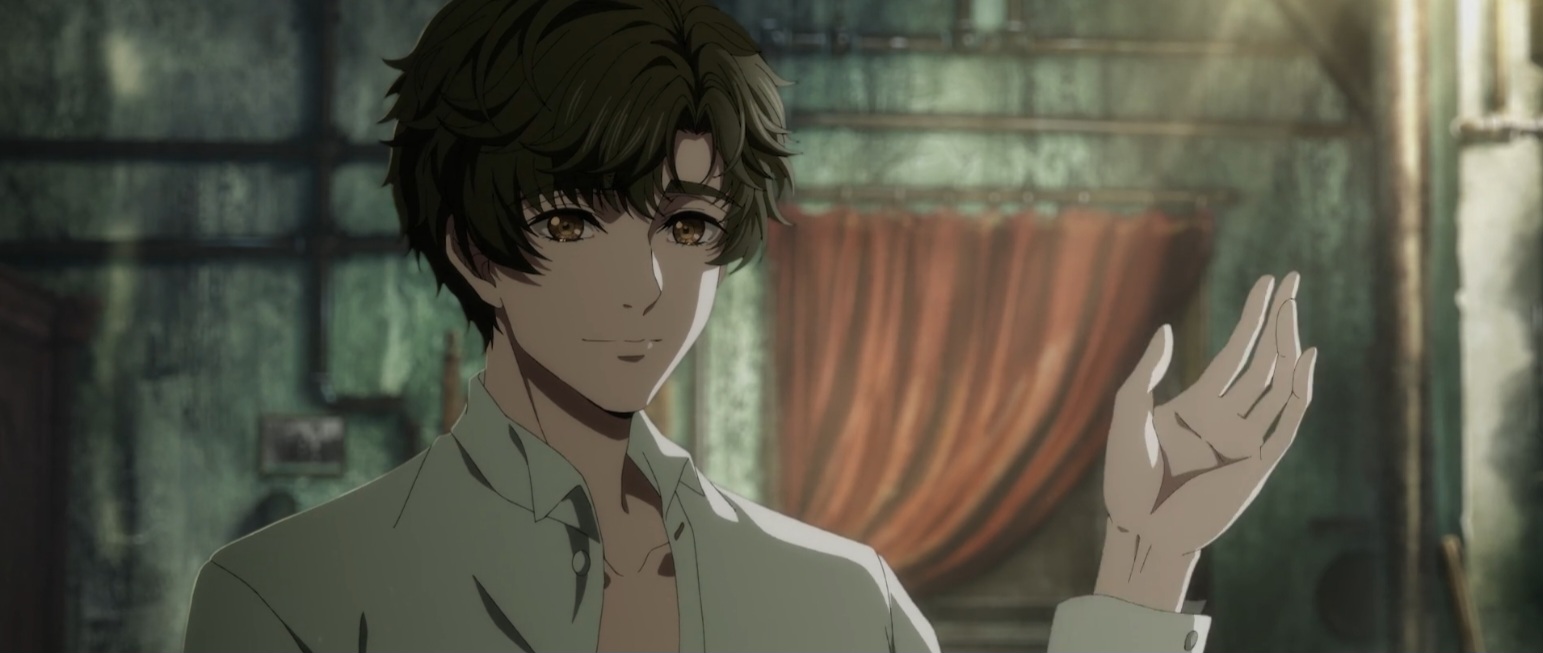
Although credited as a Lovecraftian horror, the Chinese animation Lord of the Mysteries has a lot of occult aspects that mirror the religion of Gnosticism.
Lord of the Mysteries Episode 1 Review
I didn’t know what to expect when I started watching Lord of the Mysteries. I caught a glimpse of the donghua on a popular reaction channel I enjoy watching, and was intrigued that it was a Chinese animation.
I usually don’t watch Chinese animations (or Cdrama, for that matter) not because they are uninteresting, it’s just usually a huge time commitment to watch 30+ hour-long episodes of something. It always feels easier to watch a 12-episode anime series that’s only 20 minutes long, or a Kdrama which is usually a 12- or 16-hour time investment.

Lord of the Mysteries is an animated adaptation of a Chinese web novel series by an author named “Cuttlefish That Loves Diving”. It is set during a Victorian age-ish London and has steampunk and Lovecraftian elements that remind me of the video game Dishonored. The show also features Xuanhuan, or the “mysterious fantasy” genre that blends elements of martial arts, Chinese mythology, folklore, and magical-fantastical settings.
What interested me the most about this show was the premise of Zhou Mingrui’s reawakening in the body of Klein Moretti. Zhou had performed a ritual to improve his luck, and Klein along with his two friends had committed suicide (apparently while under possession) after reading a mysterious alchemical-like book from the infamous Antigonus family.

The ritual going sideways and transporting Zhou to another world seems less like an isekai trope and more like a spiritual “walk-in” given the occult nature of the show. For those of you unfamiliar, a “walk-in” is when the soul of one body leaves, or exchanges its place/life for a new one in a currently living vessel. A good way to describe this is if a person suffers a near-death (or death) experience like a car crash, and returns as if they were a completely different person despite having all the memories of their “past” life mixed in with unaccounted ones, along with a completely different personality.
In the show, this process is called a “transmigration”.
Another aspect I found interesting was the intro’s Divine Tree of Knowledge that showed those powers “Beyonders” can wield and their supernatural abilities. (I guess the name itself “Beyonder” is a play on those who can go “beyond” the veil between worlds and realities.) The concept in the story reminded me a lot of the (previously considered “fallen”) angel Sophia and her Tree of Emanations.


I guess this tale is attributed to the Gnostic religion now, but remnants of her story are within the bible, the Kabbalah, and even Irish mythology as their Goddess of Wisdom (and my namesake -) Sionna.

Sophia (like many other biblical and spiritual figures in history and mythology) makes her presence known in Japanese RPGs like Shin Megami Tensei V: Vengence as Sophia-Pistis, or in Final Fantasy through the character Sephiroth. As Sephiroth are what the emanations on the Aeon’s Tree of Life are called. In the Gnostic religion, she is also considered to be an emanation, or female aspect of the Supreme Creator God – or the “God of Law” in Shin Megami Tensei V: Vengeance’s world, with Yaldabaoth being a primordial emanation (a corruption, or demiurge) of the creator’s dark side.
This is where the “Lovecraftian” lore enters the story, despite these very ancient scriptures and texts being the inspiration and basis for H.P. Lovecraft’s stories, and Cuttlefish That Loves Diving’s basis for the story. As they most likely found the ancient texts in Chinese that align with these belief systems before all the world’s knowledge in the form of “mythologies”, histories, and folklores were broken up, changed, hidden, and slightly altered by tongue to make every religion, philosophy, and belief in this world seem “different” and “foreign” from one another – when in reality that is the furthest thing from the truth.

But, tell me your thoughts: have you watched episode one of Lord of the Mysteries yet? Do you find the occult elements in the story to favor Gnosticism or Lovecraftian horror, more?
Leave your thoughts in the comment section below, we’d love to hear from you! Also be sure to follow us for more Lord of the Mysteries Reviews!
☆ In Asian Spaces




Leave a Reply