
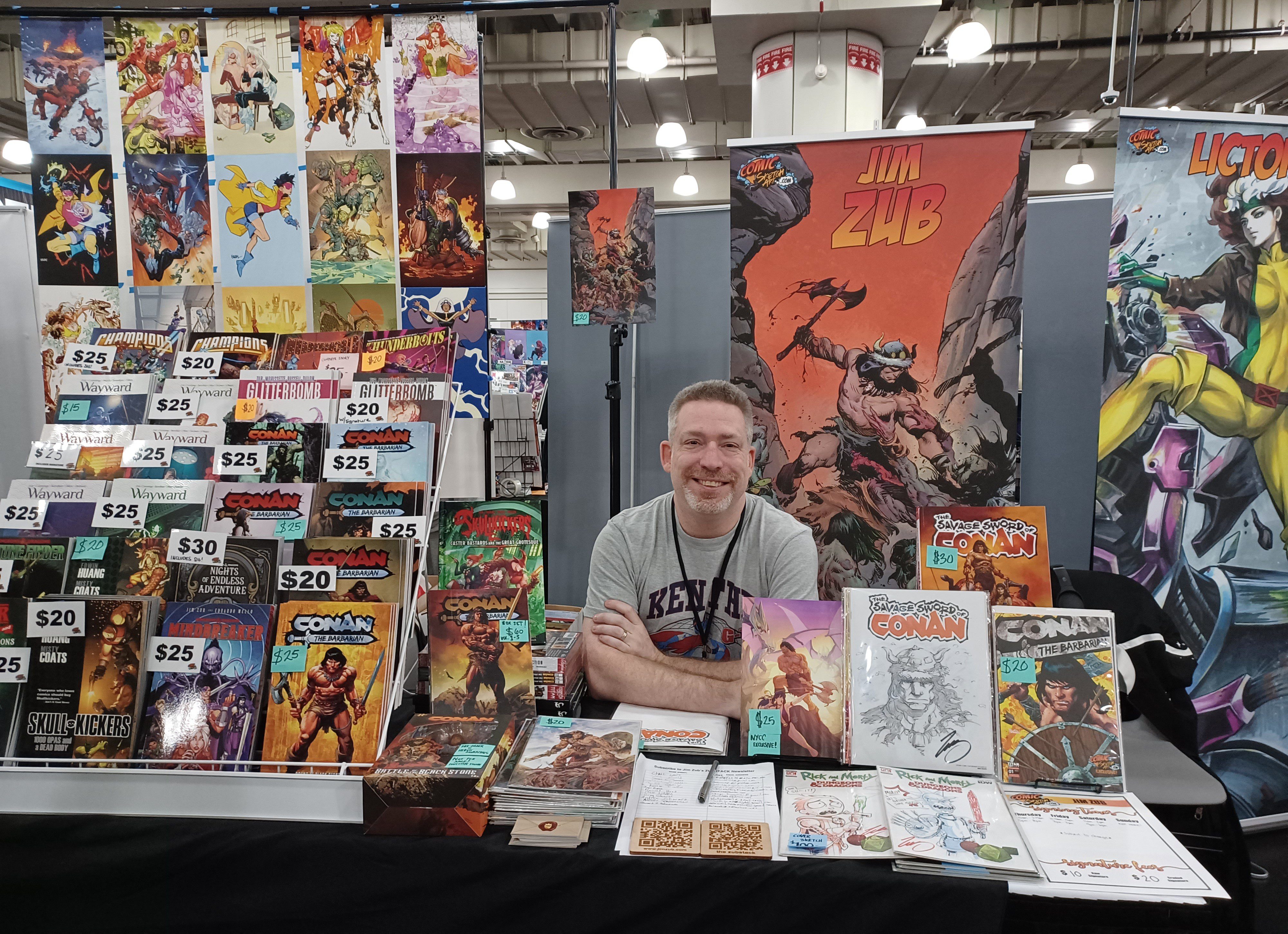
Canadian comic book writer Jim Zub took time out of his busy New York Comic Con 2025 schedule to discuss his acclaimed work on Titan Comics and Heroic Signatures’ Conan the Barbarian: Scourge of the Serpent. Zub reveals that the legendary warrior is older than Superman, with roots deep in the Pulp Fiction era that profoundly influenced the sword and sorcery genre.
Our conversation dives into Conan’s enduring legacy – from the iconic art of Frank Frazetta to his run saving Marvel Comics in the 70s – and how Zub is now balancing that history with the bold decision to tie the comic’s narrative tighter than ever to the Cthulhu Mythos.
The writer details his collaborative process, including working with an archaeologist and pulp historian, to ensure he honors the spirit of Robert E. Howard while charting a vital new path for The Hyborian Age.
Conan: Older Than Superman and Rooted in Pulp Fiction
Warmly offering me a seat, I sat down with Jim at his Artist Alley booth just as the doors had opened to begin another long, but rewarding convention day.
Based on research I was conducting surrounding the lore and the nature of Anne Rice’s vampires in her novels, The Vampire Chronicles and its TV adaptation, Interview with the Vampire, I was led to the sword and sorcery literature of Robert E. Howard’s Conan the Cimmerian.
I shared this with Jim when I first sat down, because for some odd reason, I felt the (internal) need to justify aloud why someone running an ‘anime blog’ would be interested in a traditional, long-standing comic book series. This is how our conversation begun.
In Asian Spaces: “It’s really interesting, too that you’re doing Conan because I was doing research on…have you ever heard of Anne Rice’s The Vampire Chronicles?”
Jim Zub: “Yeah, of course”
In Asian Spaces: “Yeah, I’m going to the panel tonight for The Vampire Lestat…”
Jim Zub: “Great”
In Asian Spaces: “And I was looking for more about Akasha, the Queen of the Damned. And then that took me to Howard’s work, and then that’s what brought me to Conan.”
Jim Zub: “That’s all rooted in the Pulps, right? So, Conan is older than Superman. Originally in the 1930s. And that same kind of influence finds its way into the Gothic literature, but then also the Pulps are a big influence on Anne Rice as well, for sure.”
The Pulps were fiction magazines that were published from the late 1890s until about 1955. Receiving their name from the cheap, inexpensive “wood pulp” paper used to print them on, magazines of the time were often printed on higher-quality paper and nicknamed “glossies” or even “slicks”.
Primarily catering to the American market, there were also British pulp magazines published between the Edwardian period and World War II. Several key pulp writers emerged during this time, including Talbot Mundy, Abraham Merritt, Edgar Rice Burroughs, and of course, Robert E. Howard.
The Enduring Legacy: Frazetta, Marvel, and a Generational Fan Base
Jim went on to speak about the history of the character Conan, and his influence on comics – which I greatly appreciated as somebody new to Conan’s legacy and its revival. I am not an expert in any way concerning this topic, and Jim proved to be a wealth of knowledge.
“One of the things that’s interesting is with the relaunch that we did in 2023, we’re finding a lot of new readers are coming in the door, which has been really exciting for us. But the character really has got a generational fan base. It got people, old enough to be my grandfather, who’ve been reading since the 30s and the 40s. Then the paperback kind of fantasy era of the 60s and 70s. So, do you know who Frank Frazetta is?”
I shook my head no.
Jim continued, “He’s a very famous illustrator and he created these series of covers that became iconic. And so, the paperback reprints of the Conan stories literally sold millions of copies on the backs of that artwork. And that kind of branded the character from now on. That became the vision. And eventually, Conan comic books started in the 1970s.
And when Marvel was sort of on their back legs a little bit, Conan was one of their best sellers. It was Star Wars comics, Conan and Spider-Man that kept Marvel afloat through the 70s. And then in the 80s, you’ve got the Arnold Schwarzenegger movie. As his career was just getting started, that really propelled him to a new level. And now, through the 90s, there was an animated show. And in the 2000s…”
In Asian Spaces: “There was a movie, right?”
Jim Zub: “Well, there’s the Momoa movie in 2011. And now you’ve got video games. And so, the character really has had this pop culture identity and has always kind of evolved, and met a new audience and brought that kind of sensibility forward. So being a part of that legacy is, it’s surreal, honestly. I grew up on this stuff. And so, I never in a million years imagined I would get to chart the path of a character with such a storied legacy.”
Scourge of the Serpent is introducing the true unspeakable power of Set and linking the Hyborian Age “to every other age” linked to it. Can you discuss the challenge of escalating a threat beyond Conan’s usual scope, and what it means to tie the Serpent God’s influence into a cosmic or time-spanning threat?
Jim Zub: “Robert E. Howard, the creator of Conan the Barbarian, that’s the character he’s most famous for. But he wrote hundreds of pulp stories, and he wrote westerns, he wrote horror stories… Do you know the difference between horror and Lovecraftian horror?”
In Asian Spaces: “Yes, I love that stuff”
Jim Zub: “He wrote stories that are set in the same kind of continuity as a lot of the Lovecraft stuff from the Cthulhu mythos. One of the things that I wanted to do when we relaunched Conan was to tie it even tighter into that broader mythology. Cause it’s always been there, but it’s always been kind of in the background. So, Set the Serpent God and the Cthulhu mythos and all that stuff is sort of looming in the background of what we call the Hyborian Age, the sort of mysterious prehistory that Conan exists in.”
As Scourge of the Serpent is a story that takes place between three different, distinct time periods all at once, Jim drew on other time periods in high fantasy like the Thurian Age, “an even older kind of high fantasy era” where Howard’s stories about Kull of Atlantis take place.


While admitting that it is a challenge tying together stories over vast periods of time linked to the Pulps, the comics now tightly weave together the original threads left behind. “It’s a challenge, but it’s also kind of a legacy that we’re plugging into. And taking other characters that Howard created and now using Conan, who’s a big pop culture icon, and bringing readers to these other characters as well and saying: look, it’s all linked together.
This evil is beyond time. It’s beyond reality. All these heroes are going to be drawn into this danger. And if you like Conan, you’re going to love this because it’s all part of this bigger myth.”
Jim spoke about a colleague he works with named Jeffrey Shanks, a pulp collector, historian, and a literal archeologist who loves the Conan lore.
“We talk about the original work and he’s been great at pointing me towards really obscure bits of material and references that I can then incorporate into the stories…It’s just that kind of collaborative process and the amazing artists we get to work with.
On Scourge of the Serpent, I’ve got Ivan Gil and Joao Canola, and they’re phenomenal. On the regular monthly series, guys like Fernando Dagnino, Diego Rodriguez, we’re all super passionate about this stuff and I think people are seeing that on the page every month.”
In Asian Spaces: “It shows, it comes through because I was reading ‘Scourge’ on the train ride here. It’s fantastic.”
Jim Zub: “I appreciate it”
The ‘Scourge’ series spins off from Free Comic Book Day, and features three, stunning supernatural stories weaved together, including a younger Conan, and a modern-day occult investigator named John Kirowan. How do you approach structure in such a complex, interlocking narrative to ensure that each timeline still feels essential and the story remains cohesive to the reader?
Jim Zub: “I think it’s important knowing that each character is going to have their own dramatic arc, then figuring out where those kinds of echoes and linking points are.
The story of Scourge of the Serpent is using source material from three Howard stories: one’s called The Shadow Kingdom, the other one’s called The God in the Bowl, and the third one’s called The Haunter of the Ring. So, there’s already existing material. And there’s a lot of shared symbology between them of snakes and circles, and rings and echoes.”
Since those stories and the overarching themes of snakes, circles, and rings existed, Jim and his team were tasked with making those echoes of the past more interesting, highlighting that “the villain is beyond time” in a narrative that could be played with, and open to interpretation.
Jim Zub: “The characters are still perceiving linear time and doing stuff. But you, as the reader, get to step outside that and realize there’s these broader echoes happening. And you’ve got the benefit of seeing the whole picture sort of revealed towards you. So, it’s a cool narrative challenge. It’s a fun, creative writing challenge. And the more we kind of get into it, it’s a lot of sticky notes, a lot of scene planning, and then being like, ‘okay, that’s the linking scene between these two. What is the line of dialogue or the symbol I can use to then transition through it?’”
So, your current run features a younger Conan. What storytelling opportunities does that provide you that differ from writing the veteran warrior, or a King Conan, especially when facing a Primal Evil like Set?
Jim Zub: “So young Conan is one of my favorites to write because he’s so unhinged. He’s very certain of himself. He’s courageous, but he has not experienced a lot. So, he’s all kind of, you know, piss and vinegar. Like he’s in, he’s pushing himself out into these spaces and confident he can win. And he usually does, but at great cost.
He’s not stupid, he’s still very capable, but he’s got that youthful vigor, and it’s all gonna work out. He isn’t the scarred kind of veteran warrior that is lost very often, and so he’s a fun character to sort of throw against overwhelming odds, and then the blind kind of courage carries him through. And like you said, very different from the king or the veteran.
I like the character because I never have to worry about ‘why would he do a thing?’ You’re like, there’s treasure there, there’s a challenge to be overcome. He’s just, ‘I haven’t done that before’. And he’s overtaken by wanderlust. So, the act of ‘I haven’t done that before’ is enough. There’s also riches to be had. And so, he’s a very easy character to sort of point towards a thing. And then he charges forth.”
You have done extensive writing for Dungeons & Dragons and the creator-owned Sword & Sorcery, SkullKickers. So how has your experience designing world-building and character motivations for D&D informed your approach to The Hyborian Age? Which in its essence, is like the original Fantasy RPG setting.
Jim Zub: “I grew up on D&D, and Dungeons & Dragons really changed my life. It made me go from wanting to just read or watch stories to wanting to make my own. So, getting to work on D&D…I’m so proud to be a part of that legacy… Conan was part of that as well, the ability to read these sword and sorcery stories that felt like the Dungeons & Dragons adventures that my brother and I wanted to create.
And getting to be a part of these franchises, whether that’s D&D, or Conan, or Marvel superheroes, or Rick and Morty, or Samurai Jack, or any these things I’ve had the chance to work on, I’m always sort of pinching myself because it’s so cool. It’s the things that I grew up on, the things that I love, and now being able to add something new to it feels really, really special.
And D&D is such a creative kind of stew, it’s got so many different influences in it. So, you can sort of pull out the things that you think are coolest or most interesting and find stories to be told there, and characters to add to the mix, which is great.”
Balancing Honor and Reimagination in the Hyborian Age
What was the angle for Scourge of the Serpent that you knew would immediately excite both long-term Conan fans and new readers?
Jim Zub: “I think the idea that although we’re using pieces from stories they know, we’re going to take them in a different direction, that there are surprises and cards to be turned. By Issue Four of Scourge, even if you’ve read those original stories, you’re gonna realize we’re deviating from them for a very specific reason, and there’s a big payoff to be had there. And we’re already seeding evidence of that in the first issue.
And already I’m getting questions from readers like, ‘I thought this was this’ and I’m like, ‘you thought it was but just wait’. And if you don’t know the story, there’s still something exciting to be seen there just on its own merits. If you’re a long-term fan and you think you know where we’re going, I bet you don’t. And that’s kind of the fun bit for me as a fan, and as you know, a creator.”
Conan the barbarian is one of the most enduring, adapted, and influential fantasy characters of all time. When you sit down and write, how do you balance your desire to reimagine or escalate the mythology, with the responsibility of honoring the core themes established by Robert E. Howard?
Jim Zub: “That is a damn good question. It’s something I ask myself almost every time that I work on it. When you’re in the middle of making a story, you’ve got gut instinct, you’ve got reference material, and you have what you love as a fan about it. And you have to trust that what entertains you will entertain, hopefully enough of the fan base…If I can surprise myself, or excite myself, or excite the artist that I’m collaborating with, you hope that energy and excitement carries over to the printed page.
And that doesn’t mean that I can never make a mistake, but you hope that the fan base understands that it’s coming from a place of love, and respect, and excitement. And if we don’t push on the edges and if we don’t do new things, then this stuff will grow stale, that this will atrophy and die. And you’re like, no, the reason why the character has 90+ years in publishing and over 50 years in comics is because creators are always building something new and always pushing on those edges. And that’s my job right now for as long as I’ve got the baton and I’m running as hard and as fast as I can.”
Thank you for a great interview, Jim!
You can read and purchase Conan the Barbarian: Scourge of the Serpent and the monthly Conan the Barbarian comic over on Titan Comics’ official website. Stay up to date with Jim Zub and his upcoming projects and adventures by following his official blog.
Are you a long-time Conan the Barbarian fan, or a new one just getting into the legacy comic book series?
Leave your thoughts in the comment section below, we’d love to hear from you! Also be sure to follow us for more Interviews at New York Comic Con!
☆ In Asian Spaces ☆ Ephesians 6:12 ☆



Leave a Reply