
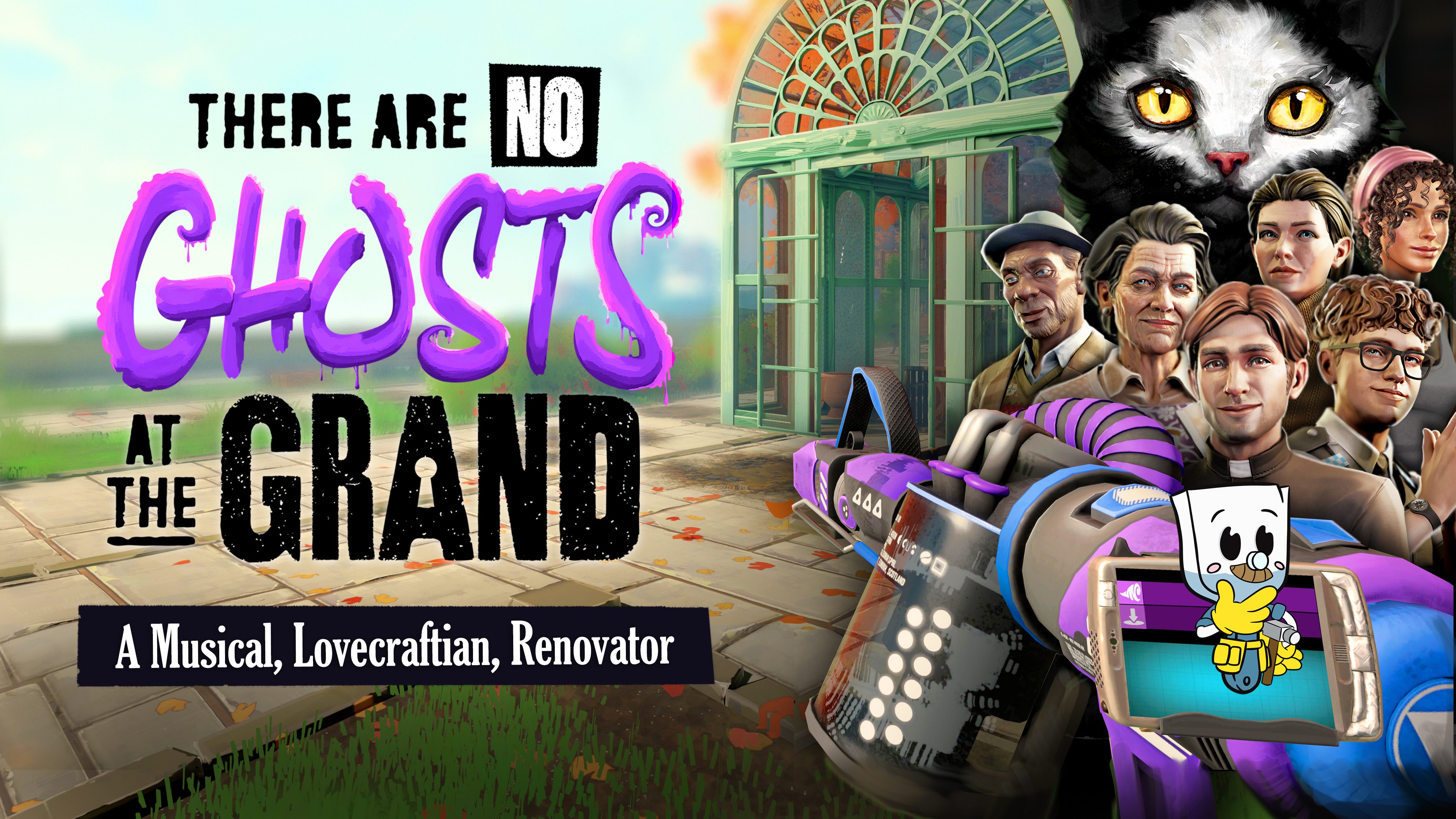
There are No Ghosts at the Grand is a mystery video game that explores the passage of time and the ‘ghosts’ that can influence our memories of events. The Tribeca Games Award-Winning work is a musical renovation game influenced by Lovecraftian lore, developed and published by Friday Sundae.
Tribeca Festival 2026: ‘There are No Ghosts at the Grand’ Interview with Anil Glendinning
We had the opportunity to speak with Anil Glendinning, the Creative Director of There are No Ghosts at the Grand while at Tribeca Festival. In a conversation filled with passion and a wistful recollection of his nation’s past, we learn more about the musical influences that shaped the game, and the ghosts you might meet along the way.

The Partnership of Cosmic Horror and Musical Theater in Video Games
In Asian Spaces: “Lovecraftian lore is traditionally rooted in isolation, cosmic dread, and things that defy human expression, whereas musicals are entirely about outward emotional expression through song. How did you balance that creative tension?
Does the music serve to make the cosmic horror more palpable to the audience, or does it heighten the absurdity and dread?”
Anil Glendinning: “ One of the key things about Lovecraftian horror and cosmic horror is how it alters your belief, your reality, and how you see the world. Often this is expressed in characters literally going mad or insane, but often they can also hear things. They can also see things, and their sense of the rules of the universe, of reality, are shaken.
Now, I don’t know about you, but that happens to me every time I watch a musical.” [Laughter]
In Asian Spaces: [Laughter] “ Yeah, me too.”
Anil Glendinning: “ You are expected to take a certain level of disbelief when characters suddenly burst into song in the middle of a musical, and you are sitting there and having to suspend your disbelief at least initially during the beginnings of the song.
We found these two things to be a surprisingly palatable partnership, between musicals and the musical sections in which you’re not 100% sure of what you’re seeing is completely real. We establish it quite early on that our protagonist, the character that you play, Chris David, is an unreliable narrator.
So not all aspects of his reality seem to be real, and you are left with the question of how much is this Lovecraftian entity affecting the world, your senses, and the characters around you. So that surrealness, that uneasiness, that uncanniness is all very much part of it.”
Balancing Cosmic Dread with Outward Emotional Expression
In Asian Spaces: “ That’s fantastic! It sounds so interesting, it’s such a great premise. In theater, songs usually happen when a character’s emotions become too large for prose. In There are No Ghosts at the Grand, what triggers a musical number?
Could it be Chris’ psyche degrading as the game progresses?”
Anil Glendinning: “ It can be, yes. We’re not a traditional musical in that sense. We kind of like to describe ourselves as a dusky kind of a reggae, ska, punk album that you might find hidden under a collection, all dusty and old from the ’80s. So, it’s very much rooted in a sense of place.


We grew up in the UK in the ’80s. It was Margaret Thatcher’s Britain, it was Ronald Reagan’s US. It was very much about nuclear armament, concern about the Cold War. But also, a lot of youth unemployment, and a lot of changes in the working society. Which sounds rather familiar to what we’re doing today.”
In Asian Spaces: “ Yeah, it does.”
Anil Glendinning: “ So the music from that period kinda speaks of a frustration. It speaks of an anger. And so it’s when our characters are experiencing some of these feelings, when they are angry, when they are frustrated, when they really wanna shout out, they sing these songs, but they don’t sing their hearts out. Sometimes they growl it out. Sometimes they shout it out.”
In Asian Spaces: “It’s a lot of emotion in the performance”
Anil Glendinning: “I think it’s about things that we can all kind of express. They’re in this town which is falling apart, this seaside town that has seen better days, and they’ve been robbed of their futures, but they can’t quite escape it yet.
And you, as this young American character who has inherited this symbol within the town of this former glory, are having to deal with all of this, as well as having your own problems. And then to add to that, there is also a monster lurking underneath the surface that may be real, it may be metaphorical, you know?

And so, the music kind of really wraps itself into that. But we wrote it organically, so when the story felt like it needed something, like when perhaps a traditional director might just bring in a musical score in the background, it’s very much the same with ours, except instead of it being, a non-diegetic piece of music, it’s actually diegetic within the world. If not coming from a radio, then coming from a character’s mouth.”
Casting Broadway Royalty: Alex Brightman as the Unreliable Narrator Chris David
The Tony-nominated actor Alex Brightman has been cast for the role of the player character, Chris David. Best known for his work on Broadway’s School of Rock, Hazbin Hotel, and Helluva Boss, it was Brightman’s work on Beetlejuice that caught the attention of Glendinning.
In Asian Spaces: “ It’s interesting, so storytelling through the music as well. Actually, since we’re on the topic of music, bringing a Tony-nominated Broadway singer on as the lead player is a massive statement. Voice acting for a video game requires a completely different stamina and presence than performing live on a Broadway stage.
What did their theatrical background bring to the recording booth, and how did it shape the musical direction of the game?”
Anil Glendinning: “ That’s a great question. We were very fortunate to be working with Alex, and we really approached him because we were such fans of his portrayal of Beetlejuice in the Broadway show. We saw within that role, within that character, an ability to be both sinister but vulnerable, to be funny but also powerful, and serious as well. Alex has such a tremendous range, but also a fantastic ability to improvise, to think on his feet.
Our development process when we’re working within the recording booth is to encourage the actors to bring part of themselves within that. So Alex has treated our lines as a jumping-off point, and it’s helped us keep our characters authentic. I don’t know if you can tell, but we’re not American.”
In Asian Spaces: “ Yes, yes”
Improv and Authenticity: Allowing Actors to Shape Slang and Script Dialogue
Anil Glendinning: “And so, there have been examples of Europeans or Brits writing American characters and just not quite getting that authenticity. We have a cheat code, and that is to hire actors who are not dissimilar from the characters that they’re playing, and allow them to kind of inflect some of their own slang, some of their own word usages and to call us up when they say, ‘Yeah, we don’t say pavement. We say sidewalk. Don’t make us say that.’

So the same has been true with many of the other actors, some of whom are unannounced, but are also from around the world, in order to find that kind of authentic voice. So it was really when you are on theater, you have the script, but you have to be prepared to improvise as well.
Depending on what happens live on that stage, audiences may laugh or cheer at different points, and your cues and positions may be slightly different, and even technical problems, heavens forbid, may actually happen. Maybe not so much on Broadway, but in certainly some of the smaller theaters, that can happen.
And so, Alex’s ability to just get the script that day and go, ‘Right, I’ve got it. Let’s have a play around.’ was just critical for the authentic portrayal and funny delivery that we’ve been trying to achieve with the game.”
Interactive Leitmotifs: How Player Choice Rewrites the Musical Score
In Asian Spaces: “ How did you approach composing a musical score where the player kind of controls the pacing in a game?”
Anil Glendinning: “ So initially all of our songs have to work as pieces of background music, something that matches the environment, matches the mission, or the tone of the current story which you have in a game. Then during that moment, the singer can join in and start singing, sometimes in a way that’s surprising, but not always for long.
We have a rule in our game that we don’t take player control away for more than 20 seconds. It is ultimately a video game. It is about interaction and it is about playing, so we are borrowing elements from cinema and from musical theater. But ultimately it is still a video game, and so characters may sing for just a short period of time, and then you are then introduced to making a dialogue choice or, in this case, a verse choice to continue shaping the story and shaping the character as you go along.
Now, of course, that means we’ve had to write out all of these different and separate verses. So it’s taken longer to write out these songs, but it’s been a tremendous amount of fun. We write it all internally within our studio. Some of our team play some of the instruments, and where necessary we also bring in session musicians who can play the violin, play the trombone, and most recently play an oboe, which is something that we needed.
I did threaten the team that I would write a piece that would require a didgeridoo, and they begged me not to, but I’ve not made any promises yet against that.” [Laughter]
In Asian Spaces: [Laughter]
Anil Glendinning: “ So yes, writing the music, very much like writing the dialogue, has been very collaborative between the whole team and the musicians that we’re working with, but it’s all designed to support the storytelling and support the actual gameplay within the game itself.”
In Asian Spaces: “ You said that you had to create different versions of the same song. So, does this shift based on the player’s choices in the game?”
Anil Glendinning: “ Yes, absolutely. Following on from musical theater, the same song can go very dark, and slower and quieter, or it can get lighter, and it can get brighter depending on which choice the player has made…it’s been a tremendous amount of fun, but also a real learning experience educating ourselves on how the structure of a song within musical theater works, how the tones shift and change but also go back to things like leitmotifs within that, and allowed that to inform our musical writing within it.
We are learning so much just from making this game, learning so much from Alex and other people within musical theater, but also within cinema, within script writing as well, and from our fantastic community of indie game developers, many of whom you’ll see here at Tribeca today.”
In Asian Spaces: “ We’ve seen plenty of traditional ‘ghost-busting’ and ‘demon-hunting’ tropes in gaming where players physically purge a space. By making this a renovation game, you’re shifting the objective from destruction to restoration. How does the act of fixing up the Grand Hotel tie into uncovering or resisting the supernatural lore?”
Anil Glendinning: “ So for us, telling a ghost story is never really about the ghosts. It’s about the history, it’s about memory, it’s about repressed events that you don’t want to talk about. Ghosts are the things we don’t want to talk about, the painful memories, the difficult histories.
So setting the game within the UK, there’s no shortage of those kind of stories that we have. So for us, renovating is in some ways about destruction because firstly, you have to strip away what was there and uncover the layers beneath it. Often both literally and figuratively within the game, you will find clues hidden behind peeling wallpaper, or letters hidden beneath curtains or carpets as you strip them away.
You’re then looking to restore these rooms as to how they may have been in the past, learning about the history of that room as you go, and learning about the hotel. And we set it within a hotel because really, we wanted to tell an anthology of stories, that really covered about 100 years of British history right from really the end of the British Empire coming up to modern days. Well, I say modern day. The game is set within 2001, but I’m ashamed to say that doesn’t feel that long ago for me…”
In Asian Spaces: “ It really doesn’t, especially after the pandemic…”
Anil Glendinning: “I think it’s quite fun and interesting writing these characters. You knowing the future, but they don’t know that…for them, 9/11 has only just happened. For them, the internet is still fairly new, but it’s before social media. It’s before the pandemic and so they don’t know how these events are gonna shape the future, and they don’t know how some things are just gonna come out of the blue and change all of our lives.
So it’s really interesting to write characters like that before knowing the audiences will see certain lines as foreshadowing for the future that we’re all living in right now. And for us, they’re ghosts of the past, but they’re also ghosts of the future, as well.
They are the specters that we don’t want to talk about, that we have to deal with in our everyday lives…the monster that is lurking under the surface of it all, and we all have a different interpretation of what is the fundamental problem…You know, there is a tentacle monster that will crawl out and you will have to use all of your gamer abilities to deal with that.
But when it comes to story, we do like to give players some room for interpretation to try and figure out what this all is.”
Embracing the “Weird”: The Vital Role of Amuse-Bouche Indie Games
In Asian Spaces: “ What do you think people should take away from this game?”
Anil Glendinning: “ You know, what we wanted to do is create something a little bit weird, a little bit unusual. But, it’s not new. Back in the early days of the PlayStation 2 and the first Xbox, game developers were still trying to figure out for this new generation of 3D games what a game means. We’ve just come out the CD-ROM era of full motion video games, and we had options for more storytelling, so games were a little bit stranger, a little bit weirder.
They weren’t so established within existing genres, and you could very easily pick up a game like, Clock Tower or Viva Piñata that were unusual, but still fantastically fun.”
In Asian Spaces: “ Yeah, I remember those.”
Anil Glendinning: “And so we want players to have fun, really enjoy the game, enjoy the gameplay, and enjoy the fact that it is a little strange, that it is a little out there. That is very much what we’re trying to create for them.
And so what we’re hoping to do is that they come away with an experience thinking, ‘You know what? I think I’m gonna try out a few more strange and weird games that are not necessarily within my genre slot’. I understand that when people are buying a Triple-A game, it’s a big investment in both time and money.
But in between those, there are these little amuse-bouches, these little indie games which you can pick up, which you can finish in like 10 to 15 hours, just over a weekend, and I think that is a great place for indie games to fit in. To be a little bit odd, a little bit unusual, and have a little bit more of its own unique voice about it because it’s not trying to hit a huge broad audience, you know?
So that’s really what I think I’d like people to be able to take away with it, so that they feel like, ‘Yeah, this was definitely something interesting and unusual, and I’m glad I spent a few hours playing this.’”
In Asian Spaces: “Great. Thank you so much for your time.”
Anil Glendinning: “ Thank you.”
There are No Ghosts at the Grand has a demo available for download on Steam, and you can follow the game’s official website and social media regarding developments and the projected release date in Q4 2026.
Are you ready to try an indie game that is a little bit ‘weird’, but has a lot of heart?
Leave your thoughts in the comment section below, we’d love to hear from you! Also be sure to follow us for more Tribeca Festival News & Reviews!
☆ In Asian Spaces ☆ Ephesians 6:12 ☆



Leave a Reply