
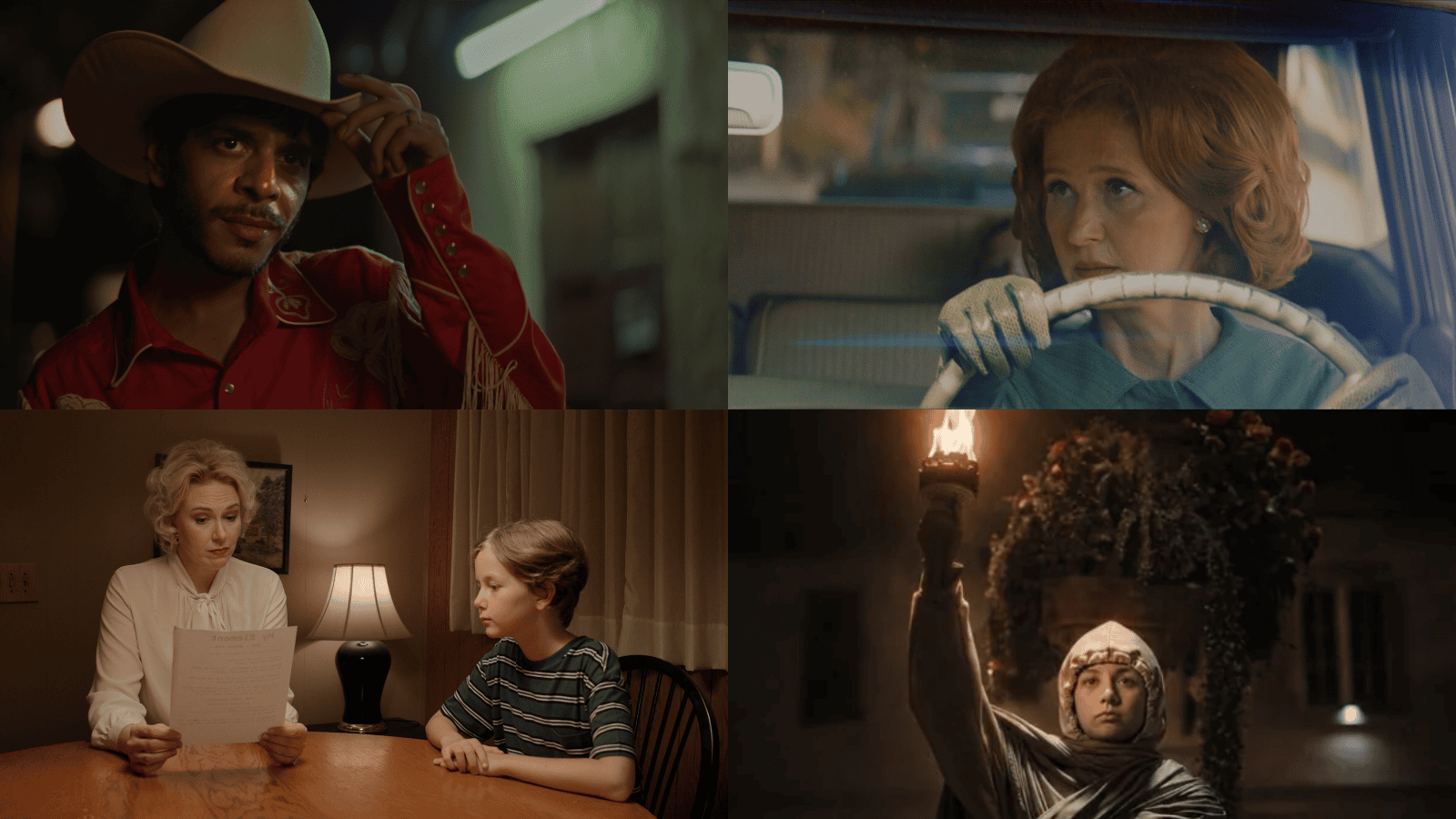
Oscar predictions have the industry abuzz in anticipation of the 99th Academy Awards in March 2027. Amongst the flurry of standout feature narratives and short films, I would like to bring to your attention four standout shorts currently up ‘For Your Consideration’ during Oscar Season.
From the minds of internationally acclaimed and emerging filmmakers alike, The Drive, I Will Be Alright, Getar Hero, and Last Minute are creative works that embody the universal themes of courage, resilience, and familial love that transcend linguistic and physical boundaries.
Moderated by Nathaniel Rogers of the Critics Choice Association (CCA), the evening of Oscar Season cinema featured a Q&A with members of the selected film’s cast and production crew after each screening.
The Q&A after each film review has been lightly edited for brevity and clarity.
The Drive – An Intimate, Near-Silent Portrait of November 1963
Synopsis: “It’s a warm November day in the early 1960s and Liz has just picked up the kids for her weekly carpool. Little does she know that this will be a drive she’ll never forget.”

Almost everybody over a certain age can recall where they were, and what they did on the day JFK was assassinated. But what if there was a missing footnote that society has collectively neglected throughout the passage of time?
Writer and director David Arrow’s The Drive explores the untold story of what happened to the eldest Kennedy daughter during that fateful day. Amber Paul’s portrayal of Liz expertly juggles the excitement of her daughter’s impending first sleepover with the horror of observing a nation in mourning, all while trying to keep the tragedy concealed from a carpool of young girls.
Q&A with Director David Arrow and Lead Actress Amber Paul
Director David Arrow has a history of writing and creating works surrounding the Kennedy family, and this short film happened to come about during research for another project he was working on.

“ I was writing a play about Bobby Kennedy,” said Arrow.
“I was astonished to find…just a few paragraphs in a book, but it was captivating what was going on with Caroline, the president’s daughter, on the day her father was shot. But more than her, it was about Liz, who was driving her, and the way Liz represented the rest of us. And seeing it through her eyes is what made me sort of go forward with it.”
Lead Actress Amber Paul was complimented on her portrayal of Liz and her ability to convey the character’s emotions despite the film having very little dialogue. When asked about the challenge of taking on a role that is “almost like silent film acting”, Paul responded by stating, “I actually did not find it to be a challenge.”
Paul continued, “ I love moments of silence and stillness in film, and letting the camera capture what’s going on within the character. To have an entire film to do that was such a gift, and my husband writes really amazing scripts. So I love to see that, because everything is so fast and dialogue-driven now. And to let people in, let them have their own emotional experience as Liz’s journey unfolds, was to me a blessing and not a challenge.”
When asked if there have been any unexpected reactions to the subtle nature of the film, Paul briefly retold her experience of hearing viewers’ personal stories of what they or their loved ones were doing on that day of national tragedy in the 1960s.
“ Something really beautiful happens,” said Paul. “People who were alive on that day come up and share their experiences with me. They’re often in tears, because they had forgotten about it, and they say, ‘Oh, I remember that was the first time I’d ever seen my mother cry.’ Because it was such a loss of innocence for the nation in that moment, and that’s also who Liz represents.
Everyone lost their innocence, and how every barrier that we have just falls away, whether it’s 9/11 in this country or going back in time to this day. And I also have young people come up with their phones out and they’re excited, and they want to know more about who he was and why his loss was such a tragedy.”
I Will Be Alright – Finding Freedom and Connection Across Borders
Synopsis: “A young girl, having fled the regime of Iran, disguises herself as a Statue of Liberty to earn a few coins.”

In the highly debated political world of undocumented vs refugee status, two teenage girls rebel against the ideology of their home nations, while finding independence through a shared bond.
Oscar-nominated writer, director and producer Cyrus Neshvad offers audiences a unique perspective on growing immigration tensions between Luxembourg and his country of origin, Iran. Centering on the Statue of Liberty as a universal symbol of personal freedom from persecution, Neshvad weaves a narrative that can be felt beyond linguistic borders.
Q&A with Oscar-Nominated Director Cyrus Neshvad
Director Cyrus Neshvad did not attend the event in person; instead, a pre-recorded Q&A session was played during his time with an on-screen moderator.

The Statue of Liberty was a prominent symbol in Neshvad’s I Will Be Alright.
When asked if that had been written into the script initially or if it developed when pondering the theme of freedom, Neshvad stated, “ I thought it was very important that in the signal, we give the signal of freedom, but under the freedom we have somebody who’s fighting for it. So, this dualistic moment was for me very important to keep.”
The relationship between Laïla (Tanaz Molaei) and Nathalie (Emily Amor) was undoubtedly the heart of the film’s narrative. With one girl displaced in a horrible situation while the other is grieving a loss, Neshvad was asked why he chose to pull “these two girls together who are from such different worlds”.
“ Because they are different, and because we all need each other in our differences,” responded Neshvad. “What I want to say is that this Iranian girl is only saved because of the Luxembourgish girl. On the other hand, the Luxembourgish girl is saved because of the Iranian girl. Why? Because she found also a way to understand, connect herself with the father, to whom finally she said, ‘I love you.’ To whom she finally gave the smile she didn’t give for two years.
It means it’s all about connection. So, she connects with the father. The mother is connecting with the child. These two girls connect together, and it’s the only way in the world that we can grow, to connect to each other in our differences.
If I can give a very easy picture, I think that we are all different flowers in a garden. It’s this difference which makes the garden so beautiful. So we can only grow in our differences, and this situation should be in the whole world. If all the countries come together and we grow in all our differences, then there will be world peace; what happened in this movie.”
Getar Hero – A Neon-Lit Bombay Neo-Western with Bollywood Soul
Synopsis: “In the neon streets of Bombay, a down-on-his-luck cowboy musician has one night to recover his stolen guitar or risk losing everything he’s playing for.”

Personal ambition and familial duty collide on the neon streets of Bombay in director Teddy Stern’s Getar Hero. A lone Cowboy (Shashank Arora) roams the city in search of a guitar, encountering tantalizing situations that could jeopardize an obligation still unclear to the audience.
The final shot of the film contextualizes the Cowboy’s plight, as a tender, intimate moment haunts the screen, as melodies of a bittersweet life protest against the starkness of a harsh reality.
Q&A with Filmmaking Duo “Sneddy” (Teddy Stern & Sneha Mehta)
Getar Hero was written by middle school friends turned filmmaking duo, Sneddy. Consisting of Director Teddy Stern and Executive Producer Sneha Mehta, the pair sought to bring the logic and storytelling of Bollywood to Western audiences; hence a cowboy in Bombay with all of the common motifs of a Western presented and culturally fused into a unique narrative twist.

The name ‘Sneddy’ can be found all over the credits of this production, and when asked about how the creative duo balances multitasking, Director Teddy Stern shared the story of how they created that moniker.
“ In this particular movie, Sneha and I wrote it together, and we go under the name Sneddy. That’s sort of a pejorative that a colleague of ours used to use against us, because we would work together so much. And we’re like, ‘You know, we like that. Sneha and Teddy, Sneddy, that works’.” Said Stern.
When asked how it was decided which scenes would be kept in the narrative, Co-Writer and Executive Producer Sneha Mehta explained that a lot of the English lines were dropped in order to appeal to the universal language of storytelling.
“ So what we refused to cut is anything that gave dimension to the minor characters. It was really important that we don’t lose any of their characteristics, because I think each one of them is having their own night,” said Mehta.
“And you could go down any of their paths, and they would have an interesting story. There’s no real villain in the movie. So, it was important that we didn’t lose anything from the side characters. The things we did end up cutting, actually, are a lot of lines that were English. I think at some point, we started wanting to make something in India, because we had spent a lot of time there.
So, it was actually the Cowboy who lost a lot of his lines, because we realized we didn’t need that, that actually the story could be universal, and that we were feeling it. We were understanding it. Our friends were getting it. In fact, everybody could get this.”
Earlier in the Q&A, Stern and Mehta mentioned that they worked at a Bollywood media company “for the better part of 10 years” and that has influenced their work and creative style. When asked about the film’s Lead Actor, Shashank Arora, Stern detailed the filmmaking process that led to Arora being hired just before production began.
“ Bollywood had a big inspiration on the film that we made, but one thing that we found is that most of the performers usually are lip-syncing, it’s mostly dubbed. We were looking for an actor who was also a musician. It was a pretty short list of people that came up. Shashank was one of them, and I think I slid into his DMs and was like, ‘Hey,’ I sent him a script. He said, ‘This is cool. Let’s talk about it when you get to India.’
So we didn’t have an actor, and we got on an airplane to shoot a movie without our main actor. But we met him at the hotel. I auditioned him…” and Stern ultimately gave him the role.
“He’s brilliant, and he adds so much pathos to the whole thing. A Cowboy in India could just be a spoof or silly. I think having him really grounds it. He never makes fun of himself or the concept, and I think that’s what makes it work.”
Last Minute – Pre-Internet Nostalgia and Community Spirit in 1989
Synopsis: “In the days before the internet, a single mom must scramble to bail out her 12-year-old son when he waits until the night before to start a major homework assignment.”

A delight to the senses for those of us who wistfully yearn for the pre-internet days of looking through an encyclopedia, or find comfort in the clacking rhythm of a typewriter in motion. Writer and director Michael Cusumano captures the end of an era that solely lives on in our collective memories.
Beyond the humor of single mother Jackie (Charity Schubert) helping her son, Jason (Espyn Doughty), complete a ‘last minute’ assignment, the film highlights the ecosystem of simple, small interactions that bonded communities before the age of the internet.
Q&A with Director Michael Cusumano and Lead Actress Charity Schubert
The chemistry between mother Jackie (Charity Schubert) and her son, Jason (Espyn Doughty), was something special, and that familial bond could be felt watching them onscreen. When asked how they cast the child actor, Director Michael Cusumano and Executive Producer and Lead Actress Charity Schubert recounted finding their ‘Jason’, Espyn Doughty, through a local theater production of Mary Poppins in Louisiana.

“ He was a dancing chimney sweep in the background of the local production of Mary Poppins in Shreveport, where we shot. Not even one of the main Banks children, but our producer in Shreveport said, ‘There’s this kid in the background and he pops, and he has a lot of personality. Also, he looks eerily like their real offspring.’” Said Cusumano.
“And then we did Zoom auditions with him, and he was such a natural and such a good listener, and just fell right into the part; we didn’t even see any other kids. We just cast him on the spot, and it was his first film ever, and he was just completely at ease in front of the camera.”
Lead actress Schubert was also given time to reflect on her experience working with Doughty.
“ Working with Espyn was incredible. I always say he showed up more prepared and more professional than a lot of adult actors that I’ve worked with. He took it very seriously, and we went down early to shoot in Louisiana, and we made sure to go out and have dinner with him and his mom…” said Schubert.
“But the chemistry was there because he was such a little 12-year-old going on 30, and he was so curious about everything, and enthusiastic about it, but in the sweetest, most sincere way, that the affection that you see Jackie have for Jason on the screen, it was not hard to gin that up.”
While the focal point of Last Minute is the relationship between mother and son, the community surrounding them takes on a life of its own as a character in this period film. When asked about the “tapestry of people” that made up the pair’s inner circle, Cusumano explained wanting to accurately portray details from that time period.
“ We wanted to get the period details right. When working on production design, we figured that no one was going to notice everything, but everybody was going to notice one thing at some point, so you couldn’t phone it in. You had to make sure every detail was spot on,” said Cusumano.
“But we really wanted the audience to believe that it was in the period, and believe 1989, and then just kind of forget about it and let that disappear into the background, and let the characters take center stage… It started out with just an idea of remembering what it was like in that time period, and realizing that kids today didn’t have it anymore.
But as I rewrote it, I realized it was a story about community, and it was about the things you lose, and you just don’t realize they’re gone until someone reminds you. And it’s a case of, this technology we have is wonderful, and it’s a marvelous convenience, and the film isn’t anti-technology. But it is asking us to say, these things that we’re given, especially these days, what is the price tag attached? What are we giving up that we don’t realize we’re giving up?
Just over the course of the film, the adults would never call each other up and be like, ‘Let’s kick around the periodic table elements. That sounds like a fun night.’ But because they’re forced into it, they make these memories that they don’t realize in the moment they’re going to treasure.”
When asked how different generations of people have reacted to the film, Schubert spoke about younger people who are unfamiliar with this time period that have a strong yearning for glimpses of daily life before technology became entwined with everything.
Also, young people seem to really love the telephones.
“ So I always say, everyone was either Jackie or Jason…folks who were alive in the ’80s and remember it, they love the nostalgia. They love being transported back to that time. But kids who were not alive during that time, they love it, too, which surprised me a little bit,” said Schubert.
“For them, they don’t have those memories. They don’t have that nostalgia. But I always say I feel like, people who remember that time are yearning for the things that we lost through technology, and younger people are yearning for the things that they never had because of technology.
So, we really do get some great responses from younger people, and they are fascinated with the telephones. They just really love seeing the telephones on screen.”
Final Thoughts: Which Oscar-Qualifying Short Film Stands Out the Most?
Film helps us escape painful realities, explore long-gone time periods, and heal through the shared commonality of the human experience. These four films exemplify the range of emotions one can experience through cinema, and are currently qualified for Oscar consideration.
If you enjoy discovering these rising voices on the festival circuit, be sure to explore our full Tribeca Festival 2026 reviews and filmmaker interviews before casting your own awards-season predictions.
Which film did you gravitate toward the most?
Leave your thoughts in the comment section below, we’d love to hear from you! Also be sure to follow us for more Film Q&As and Reviews!
☆ In Asian Spaces ☆ Ephesians 6:12 ☆



Leave a Reply