
Speed Racer, or Mach GoGoGo, is a manga series written and illustrated by Tatsuo Yoshida. Despite its original serialized print in Shueisha’s 1966 Shonen Book, the series has long endured popularity through anime adaptations, live-action film, and a new revival of the timeless franchise through comics. Even I grew up watching Tatsunoko Production’s Speed Racer anime, not really realizing its Japanese origin at the time.
Tatsunoko Production and Mad Cave Studios have teamed up to launch a set of new, ongoing comics that reimagine Speed’s story set in a “neon-soaked future” where racing is no longer just a mere sport, but survival.
Pop Culture Archaeology: Honoring the Anime Legacy of Speed Racer
The reimagined Speed Racer comic is written by Ringo Award-winner David Pepose (Space Ghost, Savage Avengers) and illustrated by fan-favorite Davide Tinto (Spider-Man, Star Wars). The colors are done by Rex Locus, with the lettering completed by Buddy Beaudoin.
At its heart, Speed Racer is a story about legacy, family, and the artistry of the race.


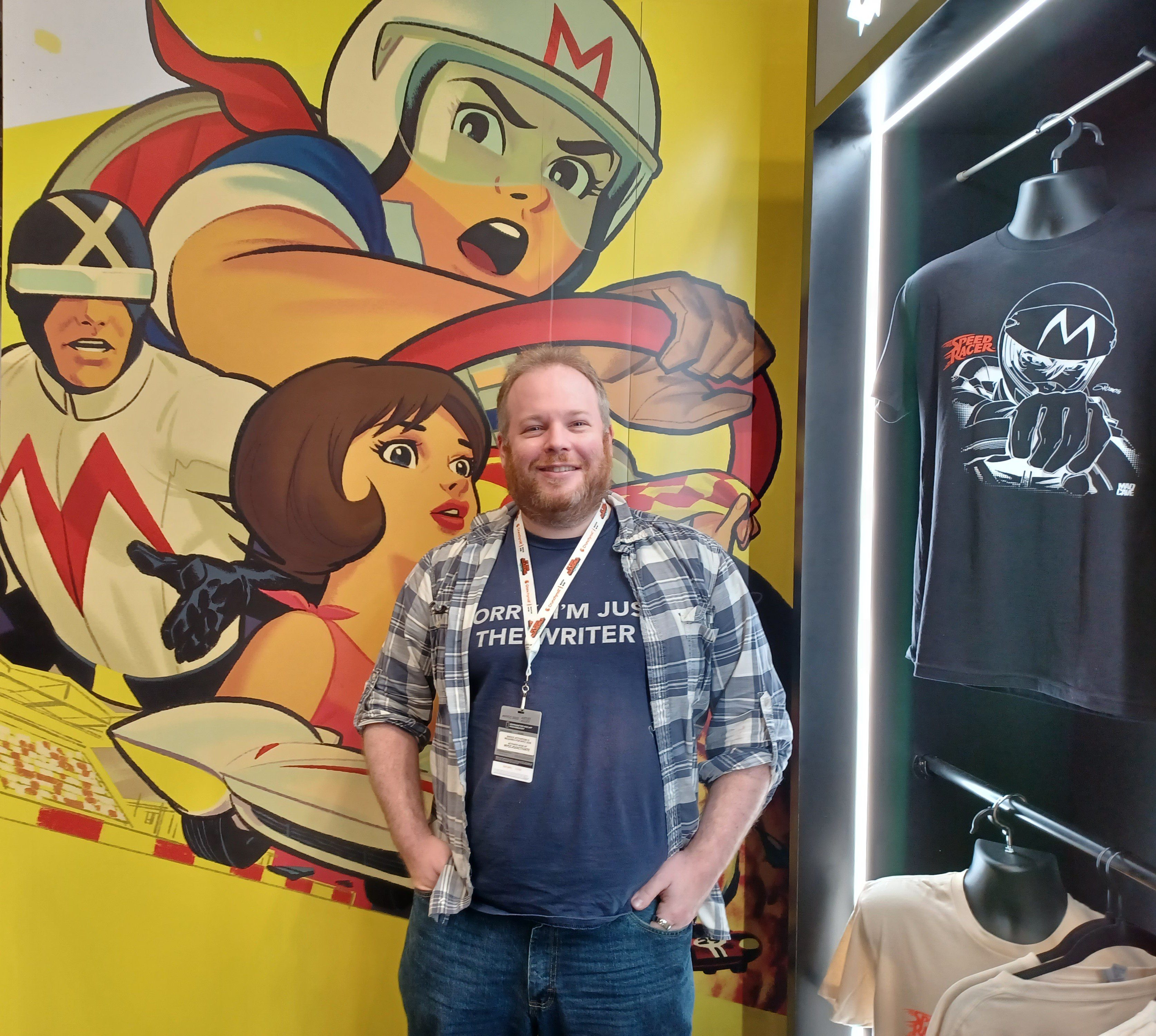
We caught up with Speed Racer’s comic book writer, David Pepose, at New York Comic Con 2025 to talk about the franchise’s enduring legacy, revival, and what the series can still offer new and returning fans alike.
In Asian Spaces: “I just want to tell you that I love Speed Racer. I grew up on it. And I don’t remember saying this, but I told my mom I was doing this interview, and apparently, my mom says I thought I was going to marry Speed Racer…”
David Pepose: “Oh, Nice.”
In Asian Spaces: “So, I don’t know, it’s weird…”
David Pepose: (laughter)
In Asian Spaces: “But I really like the series.”
David Pepose: “Thank you so much for reading!”
In Asian Spaces: “I’m glad that it’s being reimagined, that you’re the writer, and it’s amazing!”
David Pepose: “Well, thank you so much. I really appreciate you reading and the kind words.”
In Asian Spaces: “It’s a great series. So, I’m glad it’s still in the pop culture verse.”
David Pepose: “Yeah, absolutely. You know, I think for Speed Racer, it’s a character who never really left the collective pop culture consciousness, so to speak. You know, you had the original 60s anime, and then it kind of lived on through syndication and reruns, and then you had the Wachowski’s 2008 movie, which came out on the same weekend as Iron Man 1.
So, it’s a real sliding door situation in terms of pop culture. If it had been, you know, a month or so apart, we could be living in the Speed Racer cinematic universe.”
In Asian Spaces: “I mean, we still could, eventually.”
David Pepose: “You know, listen – knock on wood, maybe they’ll read our comics. Hint-hint, Hollywood.”
In Asian Spaces: (laughter)
*We both briefly look around the Mad Cave Studios booth for wood to knock on*
David Pepose: “I think there’s something really just timeless and elemental about Speed Racer. You know, people love racing. I mean, as long as we’ve had cars, people have been racing them. And even before cars, chariots, and horses, people like racing. There’s something just inherently dramatic, intense, and exciting about it. And I think in a lot of ways, car culture is culture in a lot of ways.
So that’s something I’ve been really excited to explore. But I think for me, a character like Speed Racer, there’s nothing broken about it. There’s nothing that needs fixing…”
In Asian Spaces: “He’s a good person.”
David Pepose: “Yeah, it’s just he’s such an interesting character with such a cool, supporting cast and such a very tangible, understandable kind of set of goals.
For me, it’s pop culture archaeology. It’s just finding those bones, they’re just as solid as they ever were, and just kind of dusting them off to make them shine just like new. Part of the thrill has been trying to introduce Speed Racer to a whole new generation who might only kind of know him through pop culture osmosis and saying ‘this is a character you can follow, here’s an exciting on-ramp for his stories and adventures’, and also kind of appealing to the die-hard veterans who’ve grown up loving Speed Racer and are excited to see him sort of slingshot his way across the 21st century.”
In Asian Spaces: “Great intro! Thank you”
David has a background that includes time as a crime reporter, which he mentioned earlier during our conversation. That experience seems to naturally resurface in the narrative of his stories, like the comics Spencer & Locke and Savage Avengers. I inquired whether or not those experiences also had an effect on building and reimagining Speed Racer’s modern world.
In Asian Spaces: “How has that knowledge informed your approach to building the dark street racing economy of Palm City, and the fractured family drama at the heart of Speed Racer‘s main story?
David Pepose: “It’s interesting, I don’t know if necessarily my crime background has…Sometimes, I guess, it goes into my stories a little bit, but being a newspaper reporter in general was a huge help. I think that really influences the way that I approach things.
I did comics journalism as well, for a long time. I was at Newsarama for the better part of a decade. So, I’ve loved comics for a long time. Being able to not only see the comics industry from a sort of bird’s eye view, but also figuring out ‘what do I like about certain comics, what don’t I like?’ That really informed my own toolbox as a writer.
Also, just being a journalist, like you need to write for deadlines, you stop being afraid of a blank page. I tend to write modularly, because that’s what I learned as a journalist: ‘this section works, but it doesn’t work here’. So I chop off the beginning, I chop off the end, I sort of shift it around somewhere, and then rebuild that connective tissue.
Being a journalist…I think it really shaped the whole way that not just how I write, but how I see the world. It’s the perfect training for being a professional writer because that’s exactly what you are.”
How Spritle’s Modern Reinterpretation Became Key to the Family Dynamic
You’ve aged up Spritle to be Speed’s pitchman and social media manager. What motivated that specific character to age up and reinterpretation? And how does this play into the theme of legacy essential to the new Speed Racer comic?
David Pepose: “That’s a great question. So, you know, I rewatched every episode of the original series when I was developing my outline for this. I wanted to make sure that I came at this series from an honest place, that really kind of played fair with our readers, and really kind of explored the various bits of mythology that Speed Racer has to offer. I view continuity as a tool. For me, it just gives me more material to work off of. So, I think doing the homework is really important.”
David mentioned that nostalgia books can very much be a product of their time, almost snapshots of that time period that are frozen and need to be unthawed and updated for a new generation.

By watching the Speed Racer cartoons and utilizing his previous experience on modernizing and creating a new take for classic series like Space Ghost (which 90s babies like myself would only know from Space Ghost Coast to Coast on Adult Swim), David discovered ways to modernize the characters and bring them to a new audience, without sacrificing their core personas.
David Pepose: “When you’re working on nostalgic books like Speed Racer,or my other books like Space Ghost and Captain Planet, they’re very much a product of their time. It’s the storytelling mode of 1967,” David continued, “Watching those cartoons, I could see ways that I could modernize all the different characters.
But Spritle was the one it took me a little while to wrap my head around, because that character is very much a product of its time, and trying to play it straight, I didn’t think that would necessarily fly in terms of the tone and the world that we were building with this book.
So, the light bulb moment for me was: Speed Racer is ultimately about passion. It’s about having that dream, that thing that you live and breathe, and eat and sleep, and then going for it, and then realizing the trials and tribulations of ‘You’ve gone from sort of doing it in your own thing, to becoming a professional, to being in the majors. There’s a lot of spotlights on you.’ There’s a lot of pressure. There’s a lot of scrutiny.
And so, you are having your successes and failures, and setbacks and your comebacks, all in the public eye. For me, that passion – that really was the prism that I got to explore all the different characters.
Speed – He’s destined for this; he’s a prodigy. He loves racing, that’s his thing.
Pops, he sees it through the realm of engineering and design. He’s a builder.
Trixie, meanwhile, she’s the Carol Ferris to speeds Hal Jordan. She owns a racing team, and that’s her way of sort of keeping her family legacy intact.
Racer X, racing is sort of a means to settle scores and balance the scales.
So for Spritle, I was like, ‘What’s his take on racing if this is a racing family?’ And for me, it was: oh, he’s the color commentator!”
After figuring out the updated core dynamics for the rest of Speed’s social orbit, David came to the conclusion that Spritle’s historic comic relief archetype of simply showing up when Speed needs help or when the audience needs a good laugh could be updated in this new version through the comics.
“Being able to recontextualize him as this sort of like streetwise hustling live streamer, that was kind of my way of circling the square of giving Spritle his own sense of agency.
Leaning into, he’s a precocious kid who kind of had to raise himself in a lot of ways. He’s Speed’s younger reflection, but he doesn’t have that sort of trauma and baggage that Speed has because Spritle was so young when Rex Racer was presumed dead.
So, it’s sort of like this ghost that haunts the family, but Spritle’s too young to remember him. And that leads him to be this sort of wisecracking, innocent. Spritle has become such a fun character to write. I love the kind of kid brother dynamic that he’s developing with Trixie in the book, because they’re together a lot in the thing.
He’s always the one you can count on for a wisecrack, but also, he’s very insightful. And I think that’s something that Speed needs in his life, is the people that he’s kind of triangulated off of, so he can kind of grow up to become the racer he’s meant to be.”
Blending the Mach 5 with Fast & Furious Grittiness
What was the single most important thing you wanted to retain from the manga and the anime that you thought definitely needed to be preserved in this version? And what was the biggest change that you felt would be necessary for a modern audience?
David Pepose: “There were a couple of things I really wanted to preserve. First off, it’s just the race. That was the thing that drew me to this book in the first place. I love the challenge of being able to portray motion in comics. You know, that’s a static medium. ‘How do you do a car chase in a static medium?’ That’s something I’ve loved doing over the course of my entire career.
My second ever published book was a car chase, so I love being able to do that. You know, I think the other thing was the family dynamic. Like I was saying before, Speed is a character; he’s a fun character on his own. You know he’s sort of like Hamlet meets Rocky behind the wheel of a race car.
But I think the thing that I love so much about him is that even though he’s got that headstrong, reckless, sometimes arrogant attitude – he’s got a lot of room to grow, and he does that by bouncing off of his supporting cast.
Just like you’re different around different people in your life, that’s how speed is: You get to see a different side of him when he’s around Trixie, or a different side of him when he’s butting heads with Pops about whether or not he’s going to race. Or sort of seeing him play off Spritle, or this sort of dynamic he has with Racer X, where he sort of feels familiar, but in a way he can’t quite place. But they sort of clicked together in such a natural way.
So I think for me, that’s the really important thing. As far as any deviations, it really was just the advantage that I have coming at this retroactively.
The original creators of the cartoon wrote it as they went along. I have the benefit of hindsight. I’m able to kind of look at the whole thing and say, ‘here’s some dots that I can connect, here’s some stories that I can sort of put Speed through his paces in different ways’.”
This desire for accessibility for all incoming and returning fans is what shaped the story in its updated setting. Instead of racing for fame and glory, Speed is now almost viewing his passion as a focused, functional utility in this new world.
David Pepose: “The biggest thing I wanted was to make sure it was accessible…‘What does car culture look like in 2025? What does street racing culture look like? What is professional racing culture?’ And just being able to make this thing feel very immediate, make the stakes feel very personal, in this case, Pops having a heart attack and needing a heart transplant.
So, Speed winning the Formula X Championship is the only way he’s going to pay for that; the stakes become very real for him. He’s not doing it for glory. He’s doing it for his family. There’s no room for second place. I think those are the things that really kind of sprang to mind.
But otherwise, having kind of grown up in the modern crop of comic book writers, it’s just taking the tools that I’ve learned over the course of my career and taking this raw source material and just saying, ‘how do we portray it in modern storytelling techniques?’ And that’s been just such a treat for this book.”
The new comic has been described as blending the classic material with influences like Fast and Furious, Drive, and Baby Driver. Can you discuss how you balance those modern, gritty tones with the over-the-top charm of Speed’s car, the Mach 5?
David Pepose: “Because Speed Racer is done…it’s going to be told primarily in done-in-one and done-in-two stories, to really give readers a sense of investment, I think readers get a lot out of the words ‘the end’.
When they see that a storyline has ended, they’ve seen our characters survive. They’ve seen them triumph over the odds; they feel that much more invested. So doing these shorter stories really kind of builds a lot of reader engagement over the course of our fairly long runway. I’ve been drawing from a lot of different influences.
I’ve probably watched every racing movie, every driving movie, and I try to take different things from them. Everything from Fast and Furious to Days of Thunder to Formula One to Cars. And I’ve been able to take different pieces of it for different storylines. And then I think the mythology that you’re talking about, the Mach 5 and all the characters, that’s really our constant. That’s our foundation.
That’s always something at the forefront of my mind. And that’s, ‘okay, I know the mythology, what’s the twist we’re gonna put on it? What’s the riff we’re gonna do?’ And that’s where the pop culture influences kind of make their appearances.
I’m a big fan of injecting pop culture DNA into my work. I’ve done it since my very first book. It comes very naturally to me. And I think for me, that’s a way of trying to build up accessibility, is that – I know that comics are just influenced by comics tend to be very insular, very self-referential. It’s hard to give that to somebody who doesn’t read comics, who’s not already a fan.
I don’t want to preach to the choir with my books. I want converts. And so that’s what I try to do with all these books.
I’m like, ‘Maybe you don’t know Speed Racer, you’ve only heard of them, but I bet you know what The Fast and the Furious is. I bet you know Days of Thunder or Formula One, I bet you’ve seen Cars, and being able to sort of have that common ground, that common hook, I’ve found that makes it much more approachable for people who don’t know Speed Racer, to really get excited about the book.”
In addition to David’s work on Speed Racer, there are currently two more works in the reimagined comic book universe: Racer X and Speed Racer: Tales from the Road.
Racer X is a limited comic series surrounding the masked vigilante orbiting darker territory, balancing the legacy that generational fans have grown to love and cherish. From Eisner and GLAAD Award-winning writer Mark Russell (The Flintstones, Second Coming) and acclaimed artist Nuno Plati (Gatchaman, Marvel’s Spider-Man).
The colorist is Giada Marchisio, lettering is done by Buddy Beaudoin, and the inaugural issue features variant covers from industry talents Francesco Tomaselli (DC vs. Vampires), David Lafuente (Ultimate Spider-Man), Takeshi Miyazawa (Ms. Marvel), and Sean Galloway (Teen Titans Go).


The Speed Racer: Tales from the Road story is written by Mark London (Endless Night, Hour of the Wolf, Exit City) and David Pepose, featuring interior art by Sebastián Píriz (Gargoyles, Stranger Things), colors by Rex Lokus (Aquaman), and lettering done by Buddy Beaudoin (Speed Racer).
With cover art by Andy Clarke (Batman) and Dan Panosian (Savage Red Sonja), Shane Connery Volk (Nottingham), and Joe Quesada (The Amazing Spider-Man) for issue one, it is a quarterly release comic featuring one-shot stories surrounding Racer X and his mission to take down ‘Viking’, a brutal warlord at Interpol’s behest.
The Journalist’s Toolbox: Writing Comics for Deadlines and Converts
The stories for Speed Racer, Racer X, and Speed Racer: Tales from the Road were divided between three writers (and creative teams). How did you all coordinate to ensure a cohesive look and tone for the reimagined universe?
David Pepose: “I want to shout out to our editor, Chas! Pangburn, because he’s really taken point at a lot of that stuff. He’s the conduit between all of us. He’s the one overseeing everything. So, he really knows where all the bodies are buried, creatively speaking. And he’s able to kind of navigate what we’re doing.
But, you know, I read over most of the scripts. I’ve read, I think, the first three or four issues of Racer X, and Mark Russell’s doing an amazing job. And I read the script that Mark London did for Tales from the Road, our anthology.
I think it also helps that I wrote a very detailed outline, sort of a roadmap of what I was gonna do in the main book. Where I did it issue-to-issue, I broke it down on a page-to-page basis. And some of that is because I’d never worked with our licensure, Tatsunoko [Production], before. And so I wanted to make sure they knew exactly where we were going with this book, so there weren’t any questions, there wasn’t any confusion.
But also, knowing that there were going to be spin-off books coming, they could all see exactly what was happening, and then they could kind of like plan their books accordingly.
But at the same time, the thing I love so much about the Speed Racer universe that we’re developing is, we’re developing kind of different flavors. That we’ve got sort of the characters and sort of the common ground, but every writer is approaching it in their own different way, their own different style.
You’ve got, you know… my book, which I described as ‘like Rocky in a race car’. We’ve got Mark Russell’s Racer X book, which is more of a noir, crime kind of take to it. And then, Tales of the Road is sort of Mark London doing kind of the avenging action hero version of Racer X.
And so I think there’s something for everybody in these books, and as we continue to expand the line, you’re going to find some really interesting, unique angles for some of these characters that I think are going to draw in, hopefully as wide an audience as possible.”
Do you have a message for fans who may be on the fence about reading this amazing series?
“Listen, this book, it’s been a labor of love from the beginning. Like I said, I watched every episode to prepare for this. I think Speed Racer he’s not a character that needs fixing. He is one of the most enduring characters in all pop culture, and it’s for a reason: he’s so cool.
It’s just that his quest is so timeless and elemental, and classic, and for me, my goal is to take the biggest swings possible with this book, to be as exciting and action-packed. Every issue’s got an exciting race to it, and every issue is going to see Speed kind of coming into his own as the greatest racer in the world.
Definitely, if you haven’t checked out Speed Racer yet, Issue One just came out, and you should definitely check out our series because we’ve got a long runway planned and some really exciting adventures ahead.”
In Asian Spaces: “Thank you for your time!”
David Pepose: “Of course, Thanks for having me!”
It was an absolute pleasure speaking with David, and you can pick up his Speed Racer comic over on Mad Cave Studios’ website, along with the other stories in the universe, Racer X and Speed Racer: Tales from the Road.
Leave your thoughts in the comment section below, we’d love to hear from you! Also be sure to follow us for more Interviews at New York Comic Con!
☆ In Asian Spaces ☆ Ephesians 6:12 ☆



Leave a Reply