
Facebook and Meta Platforms’ Mark Zuckerberg, Nvidia’s Jensen Huang, Wikipedia’s Jimmy Wales, and even Linux’s Linus Torvalds – what do all of these men have in common? Aside from co-founding some of the biggest accomplishments in tech, these C-suite executives have all utilized the free, open source internet in some way, shape, or form to build the platforms we use today.
Review: Defending the Open Web in an Era of Walled Gardens
The “Enshittification” of social media, coined by author and blogger Cory Doctorow, has resulted in “Walled Gardens”, or an array of apps and websites that are fully self-contained in an internal enclosure.

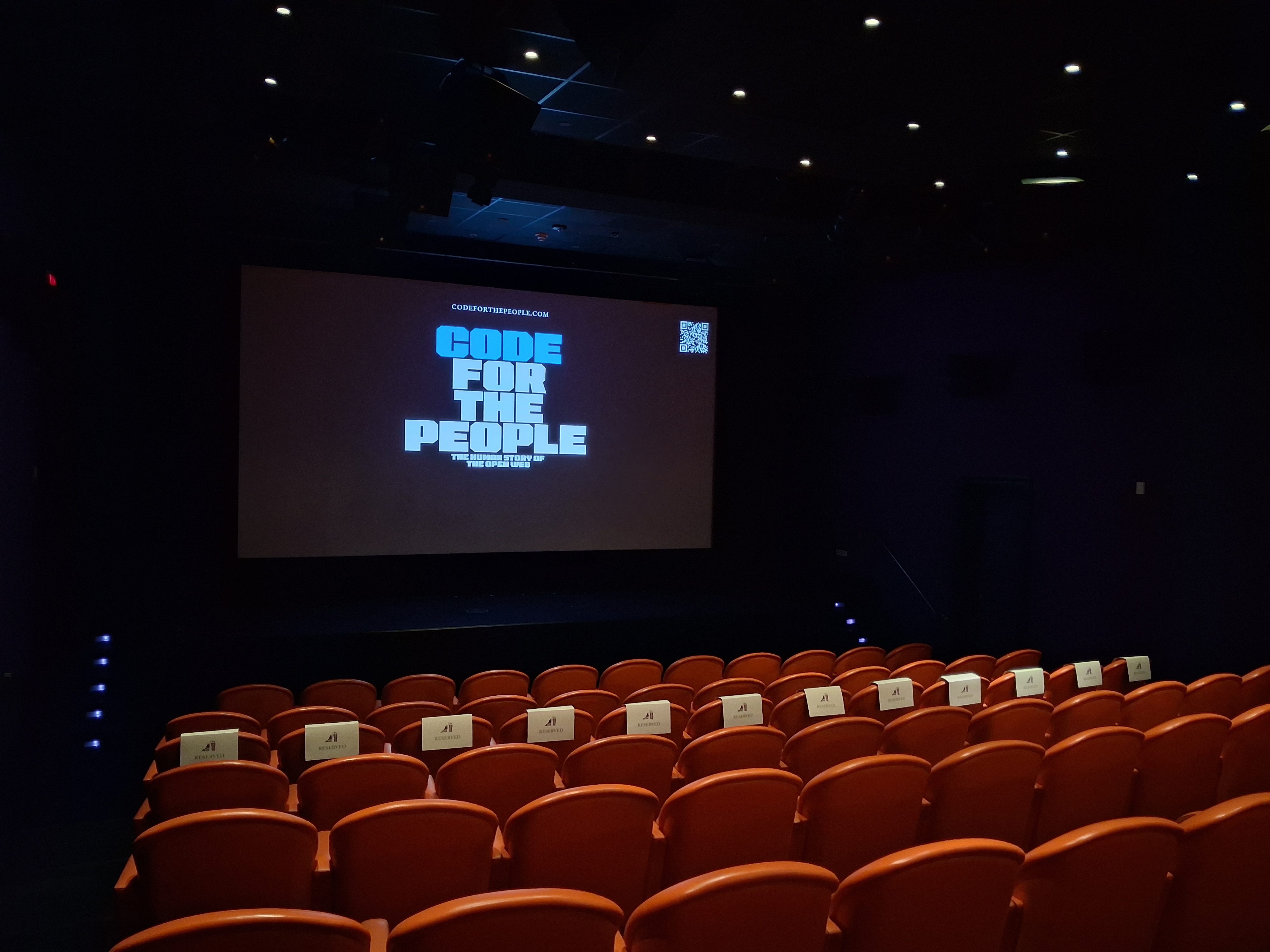
With the increasing aggression of AI LLMs encroaching on the personal freedoms of creators and threatening the very existence of the open source internet democracy, Director Bao Nguyen’s documentary short “Code for the People” attempts to tackle this dilemma head-on and offers solutions already found in WordPress co-founder Matt Mullenweg’s open source application, Automattic.
The Tech Pioneers and the Open Source Foundation
Through direct testimonies from executives, developers, and creatives in the WordPress ecosystem interspliced with archival footage, Nguyen casts a very strong case for the free and open source internet’s survival in a world increasingly dominated by ‘invasive’ AI applications.
Stemming from “The Blogging Software Dilemma” encountered by Mullenweg, WordPress was born. Through the collaborative work of Mullenweg and Mike Little, the original open source software evolved into a Content Management System (CMS) that grew to include various other platforms and brands under Automattic (notably, WooCommerce and Tumblr).
Mullenweg’s ‘The Blogging Software Dilemma’: “Well, it would be nice to have the flexibility of Movable Type, the parsing of TextPattern, the hackability of b2, and the ease of setup of Blogger…”
According to Paul Maiorana, General Manager of Automattic Cosmos, local community-based events springing from global initiatives continue the mission of keeping the “Code for the People”, further promoting innovation and fulfilling the investment necessary for the social contract of this resource for humanity.
The social contract nurtured by an open source internet and the invested time of the collective is further threatened by “Walled Gardens” that can disconnect users from their communities at any time, and on any platform without warning.
AI Encroachment and the Threat to Digital Freedom
Paolo Belcastro, Artistic Director of the Domains Maison at Automattic, argues that the free internet has removed the barrier of entry that previously required capital or copious amounts of time to create new endeavors. Both Mary Hubbard, Executive Director at WordPress, and Marjorie Asturias, Head of Operations for WordPress.com, argue the dangers of being a “tenant” of ‘Walled Gardens’, or social media platforms that can restrict access to digital real estate and the tenant’s ‘content’ at any time.
So as a collective society that has been heavily influenced by the internet, where do we go from here? Well, WordPress.com Artistic Director and Product Lead, Ian Stewart, reminds viewers that over 40% of websites worldwide are powered by the open-source, CMS of WordPress software.
The Head of Data and ML at Automattic, Matt Miller, stresses the importance of thousands of people having the ability to simultaneously crawl open source code and provide feedback, eliminating bias and enabling accountability if one group is being unfairly penalized. Walled Gardens do not provide this insight, and in the long term can potentially cause stagnation, and the degradation of innovation amongst human creations.
Despite this potentially dim, dystopian ‘Walled Garden’ phenomenon increasingly growing in popularity on our current internet, there is still hope when open source code is made easily accessible and readily available to people worldwide, transcending any linguistic or geographical boundaries.
It is in this core message that Nguyen’s “Code for the People” shines at its brightest, and provides a guiding light toward true innovation and ethical use of AI when implemented for the free, open source internet and the benefit of humanity for generations to come.
How do you feel about the ‘Enshittification’ of social media platforms and the building of ‘Walled Gardens’ by companies and corporations that cause division amongst the internet community?
Post-Premiere Q&A: Key Takeaways with Director Bao Nguyen & Tech Visionaries
Variety’s Todd Spangler moderated the Post-Premiere Q&A in partnership with Automattic Inc. Here is a truncated overview of the key points and takeaways from the discussion.

A Protopian Vision for the Future of Technology
Director and Filmmaker Bao Nguyen discussed his experience making Code for the People when prompted, and stated why he wanted to create a documentary surrounding our technological future that didn’t feel dystopian or depressing.
Bao Nguyen: “ I think one of the great privileges of being a filmmaker, especially a documentary filmmaker, is kind of being thrown into a world where you don’t belong. I’m not a technologist; I’m a storyteller. So, to be thrown into the world of open source and amongst the world of many of the people standing on the stage was a great privilege, and I learned a lot.”
Nguyen further explained his intention for the film, stating “… I was hoping that this film could both be sort of this emotional human story of why we are connected to tech, what are our first curiosities to tech and computers and the internet, and also this bigger philosophy of open source and deconstructing that for a layperson who might not know how much open source surrounds us in everything we do.”
Bao Nguyen: “ A lot of films about tech can be very dystopian. I wanted to make a film that was more protopian, that gave practical ideas of how we can move forward and learn from what values we have as human beings, and bring that into how we practice our use of technology.”
Reclaiming Ownership: Actionable Steps for the Internet Community
Towards the end of the Q&A, Spangler asked the panelists what they believe the first step the general public could take to become part of the open source and free internet movement. Here were their responses:
Paolo Belcastro, Artistic Director of the Domains Maison at Automattic
Paolo Belcastro: “ Maybe the first step is, look at the tools you use every day and who they belong to, and if they are proprietary, closed, that you can’t see inside, is there an alternative that is actually open and that you could actually change?”
Bao Nguyen, Director and Filmmaker
Bao Nguyen: “ For me, just narratively, when you think about how you interact with the world, are you a reservoir or are you a swamp, right? And using that idea and approaching things that way, that’s how I got to understand what open source was, relating to how I try to approach the world.”
Eric Binnion, Code Wrangler at Automattic and longtime WordPress core contributor
Eric Binnion: “ I’ll go slightly more action-oriented. I would challenge all of you, if you don’t already have a domain, to go buy one…You can do it on wordpress.com in probably five minutes, and that’s now your space on the web.”
Anil Dash, Prominent Technologist and co-founder of antitech
Anil Dash: “ I love all of those. The one I’d push on, is language. We fall back on convenience. A lot of you will have heard somebody say, ‘Look at my Substack.’ There’s no such thing as my Substack. You don’t own it. You can have an email newsletter. There is no such thing as my Substack.
You will see people say ‘unalive’. The algorithm is telling them they can’t use the word ‘dead’. There’s no such thing as unalive.
Like, challenge yourself to change your language to conform to what you think, and to what you actually believe and what you actually own, and not be controlled by companies that will actually shape your thoughts. They will hold you hostage through their closed system.
You can start to control your language, and control the language of those around you. Push them. Push people. Say like, ‘Subscribe to my Substack.’, remind them there is no such thing.”
Todd Spangler: “ Just playing devil’s advocate, Anil, shouldn’t governments be able to ward anti-competitive behavior?”
Anil Dash: “ That is the right answer, but we are not in a place where we have the Rule of Law.”
AI Ethics, Consent, and the GPL License Controversy
Todd Spangler: “ …I think the movie kind of is a little questioning…what the future is at this moment of big AI companies. Paolo, what does this mean?… These companies, as it points out in the movie, they’ve grown big on the backs of things like Wikipedia, which are open source, free information?”
Paolo Belcastro: “ There’s an irony there, which is that large AI companies complain about what they call model distillation. Basically, competitors trying to extract all the knowledge from their model for free. While those models were trained on all these freely available content without asking for permission, and basically reselling them the product. So this is one of those things, I think at the core of the open source license Matt mentioned, the GPL, is the fact that the license is viral.
Which means that if you take some software that is under that license, the GPL, and modify it and distribute it, you have to carry the license with it. So, you have to allow other people to modify it. It seems logical, right? That you benefited from something, you give the same something, build the same something back.
Well, those AI companies have completely broken that model. They have taken everything that was available for free, regardless of whether what kind of license it had, and then they wrap it up in a box, it’s closed, and sell it to you.”
Belcastro further elaborates that this closed box can enable things like speech censorship, a symptom of denying this natural GPL exchange that Dash also alluded to earlier.
Paolo Belcastro: “…Now, of course, some of those things are for safety, like there are very good reasons. But we also know that the safety in an open source environment, everybody can have an eye on it and check that, ‘Hey, yes, you’re applying safety boundaries, but you’re not overstepping’. In a closed box, nobody can figure out what’s going on inside.”
Todd Spangler: “ So what’s the antidote? Anybody else want to weigh in on this?”
Anil Dash: “ One of the challenges people will say about open source AI, [is] that open source AI tools aren’t as good. And the question is what we consider good.”
Dash continues to state that big AI tools care little for practicing under the consent of their users, or established web courtesies like the GPL, in general.
He continues, “ And there are still parts of culture that think consent matters. Whether the people that run those companies care, the rest of us do care. And so, those are things we can say is good is defined as caring about consent. And so, AI models that are open source inherently practice consent because we value that open source.”
Todd Spangler: “ And those do exist?”
Anil Dash: “ And they do exist. And so we can say, ‘This is what we consider good, and these open source AI models are good for our values’. And that’s one of the things that’s actually great, is there are lots of them. Especially in the Global South, especially in Scandinavia, weirdly, they love open source AI there, and they develop lots of them… There’s lots of places around the world that are developing these things.
The rest of the world is not happy about using American technology for all the obvious reasons. And they’re developing alternatives that are open. Great news is we can still use them, because they’re open source…”
Dash then gave an analogy for why there should be open source websites by likening it to the real-world economy and the monopoly certain corporations have over differing sectors of society.
Anil Dash: “It’s like thinking there should be one restaurant, right? Like, you shouldn’t have just McDonald’s. There should be lots of little Mom and Pop restaurants, and all different kinds of cuisines, right? The same is true with lots and lots of options.
These tools we’re talking about let you make lots and lots of different websites. They don’t all look the same… Cause what you get when you have one big platform is ChatGPT telling people’s children to sell pot. No, it’s true. This is a fact, right? There are still facts.”
Dash provides an example of a VFX house in Los Angeles that uses AI responsibly for a specific purpose. “… They train it on their own content with consent. It will never tell people to take themselves off ’cause it has a purpose, and it’s made by creatives for creatives, and it’s open source.”
After that rousing Q&A, the audience was led back into an adjoining room for a reception that included tons of appetizers, as people discussed the future of the free internet, invasive technology, and huddled around a provided TV to watch the World Cup while stuffing their faces with tasty appetizers.


Overall, it was an impactful evening that helped spread the word about the importance of preserving the free internet and fighting for transparency through open source applications regarding AI programs.
Code for the People is available to watch for free, directly on their official website and on YouTube. You can also follow the project on social media via X, Instagram, and TikTok.

🏮 Read More In Asian Spaces
If you enjoyed this breakdown of open-source activism, digital ownership, and AI ethics in Code for the People, explore our related deep dives into artificial intelligence, cybernetics, and corporate control:
- The Ghost in the Shell (2026) Episodes 1–3 Review: Cybernetic Ghosts & 90s Vibes – Exploring how classic cyberpunk aesthetics and cybernetic consciousness mirror modern debates on digital identity.
- Good Night World Ending Explained: Breaking Down the Pico AI, Black Bird Virus, and Betrayal – Unpacking the dark side of rogue AI systems, virtual reality enclosures, and corporate control in gaming spaces.
- Pantheon Ep 1 Review: Ghost in the Machine – Examining uploaded intelligence, corporate tech monopolies, and human autonomy in the cloud.
Leave your thoughts in the comment section below, we’d love to hear from you! Also be sure to follow us for more Film & TV Reviews!
☆ In Asian Spaces ☆ Ephesians 6:12 ☆




Leave a Reply